Today, Jane and Katherine Lee, the Katzenjammer Kids of early cinema, are almost completely forgotten, but these two little New York girls were easily the most popular child stars of the 1910s. They were in great demand. Together or separately, they appeared in dozens of movies, if only as supporting players. Their childish pranks and disastrous misbehaviour onscreen drew theatregoers to films they might otherwise have avoided. Critics praised their performances. Exhibitors demanded more. They were stealing the show. There was only one thing to do: give them their own starring vehicles. Between 1917 and 1919 William Fox featured the girls in eight comedies, and they were known as the Baby Grands. In 1919 the Lee sisters were voted the 7th biggest box-office attraction of the previous year in an annual exhibitors' poll. After their contract with Fox expired the girls formed their own company, and shot two more films in 1919, both 2-reelers. These would be their last. Something went wrong.
In 1900, Brooklyn residents Charles Hoey and Harry Levy formed a vaudeville comic duo. The order of their names was interchangeable at first, but eventually "Hoey and Lee" was established, and though their act wasn't exactly original, they enjoyed above average success, often billed as "Hebrew comedians". Using heavy makeup, they caricatured New York's Lower East Side Jews through humorous dialogue and parodies of well-known songs.
 |
Charles Hoey (left) and Harry Lee
|
In 1903, Harry Levy married an Irish lass named Irene Kinaird, who was just beginning a career in vaudeville as a singer and dancer, sometimes known as "the Manhattan girl". Like Harry, Irene assumed the name "Lee", and after an inauspicious start, she garnered some attention in January of 1906 with her new act as a male impersonator. She stepped onto the stage in "customary garments worn by her sex", and then made a couple of rapid changes into men's clothes, while singing, dancing and reciting dialogue. The diminutive young lady concluded the act as a natty boy, and was praised for her convincing appearance, though a common complaint was her poorly made wig; otherwise, the attire she chose was an investment, too expensive for the average man. She was nervous, suffered from stage fright, and sang with an "uncertain vibrato" in her voice, but was rising through the ranks of the vaudeville stage. Irene wrote her own material, and had the songs copyrighted. Billed as "the girl in trousers", she often toured with Hoey and Lee, as well as W.C. Fields, the comedic juggler, already a veteran of the stage, and newcomer Will Rogers, who performed rope tricks.
 |
"The girl in trousers", 1906
|
A few months later she added two boys to the act, and christened them her "Candy Kids"; the spelling was changed to "Kandy Kids" later in the year, but typesetters could never seem to get it right. One of the boys was Sammy Lee, Harry's younger brother, who was just turning 16. Samuel Levy started his career early, only 8-years-old, performing on street corners in the Lower East Side of Manhattan. Confident in his abilities, he answered an ad by Gus Edwards calling for boys who could sing and dance. He performed in Edwards' juvenile acts for a few years, ending with a brief stint in 1906 in the revue, "Postal Telegraph Boys", which also included a kid named Julius Marx. The eight boys were paid $15 a week when performing in New York, and $18 on the road. Sammy quit for a more lucrative job with his sister-in-law.
Sammy was an exceptionally talented soft-shoe dancer and raised Irene's act to a new level. The boys came and went: Sam Weston, who left for Leo Woods' comedic revue, "Boys Wanted", in August 1907, as well as Earl Nickel and Harry Evans, with Sammy being the only consistent member. They made their first tour overseas, opening at the Palace Theatre in London on May 6, 1907.
When it was announced late in 1906 that Irene Lee and her Kandy Boys would be going overseas in May, Harry made plans to follow her in June while on a six week vacation. Hoey and Lee had offers to appear overseas on a number of occasions, but Hoey always declined, his aversion to water being a possible reason. The duo announced that they would be breaking up, and would play their last date in April 1907: "Both the partners stated that they did not desire to make public the causes of the separation." The cause may very well have been Irene. Vaudeville tours could be notoriously lengthy, and if Irene was going overseas, she and Harry might be separated for half a year.
 |
Ad for the Hoey and Lee song book, 1911; Hoey (upper left) was the sole writer of their songs
|
But Irene and the boys returned to the States later that month. She found herself using a variation on her maiden name for a week, when they played the Lyceum Theatre in Rochester, New York. It seems there were too many Lees on the bill: Irene, Harry, and an impersonator named Henry Lee, so Harry was billed as "Harry Love", and Irene as "Irene Kainard", a variation on her own name. Irene and the boys had a new act, titled "A Scene in Holland", while Harry did a solo, "The Hebrew Street Car Conductor", in which he sang parodies and spoke of his experiences as a street car conductor, while dressed the part. Harry's act was successful, but he and Hoey reunited the following year.
Irene did another tour overseas, which opened in Liverpool November 25, 1907, this time engaged for 30 weeks on the Moss-Stoll circuit. Oswald Stoll, manager of the London Coliseum, renamed the act "Irene Lee and her Candy Boys", which only added to the confusion over the spelling of their name when they eventually returned to the States, at which time Sammy Lee left the act.
 |
Irene Lee, 1909
|
Something strange occurred in December 1908 while Irene Lee was again overseas. It was reported that she had "given up her 'Candy Kids' act on the other side, having left Liverpool suddenly, without providing for the two boys who were with her." It was irresponsible and callous, to renege on a contract and leave two kids to fend for themselves in a foreign land.
On February 14, 1909, Irene's first child, Katherine, was born in Glasgow, Scotland. Irene had been abroad for the better part of two years, and would spend the better part of another two years in Europe, Australia and South Africa. (Her mother had died January 4, 1905, in Basutoland, now Lesotho, located within South Africa.) In April, Keifer and Klein were the new Kandy Kids, though that lineup quickly changed to Klein and Clifton. Irene gave birth to her only other child, Jane, who was born in Berlin February 15, 1912. By this time she was doing a solo act once again, and having all the attention on herself was probably not to her liking. She reformed the Kandy Kids, and continued performing well into 1913.
 |
Katherine Lee
|
Irene's life was a mess. Variety reported in the March 19, 1920 issue that "Harry Lee, formerly of Hoey and Lee, is the children's father. The parents were divorced some years ago, the mother taking Jane and Katherine at the time." On March 23, Irene wrote a rebuttal, which was published in the letters page of the following issue, March 26: "In a paragraph last week concerning the vaudeville debut of Jane and Katherine Lee, you said that their father was Harry Lee of Hoey and Lee, but he is not their father. After my divorce from Mr Lee, I married Thomas Banahan (of the Five Mowatts), who is the father of the children. I am also divorced from Mr Banahan. The error caused me to tell you the story of my life, but I am sure that under the circumstances you will not mind making the correction. I hope this does not give any one the impression that I am hard to get along with (as some moving picture directors claim)."
Irene spoke the truth when she said that she'd married Tommy Banahan, a juggler with a troupe called the Five Mowatts, another vaudeville fixture. But she wasn't telling the whole truth. An article in the October 29, 1910 issue of Show World stated "Irene Lee will probably get a divorce from Harry Lee, of Hoey & Lee, when the case is to be heard in the Chicago courts today." And in the October 14, 1911 issue of Variety, a related article appeared: "Word has been received here from Irene Lee, who went to England shortly after her divorce a few months ago from Harry Lee, of Hoey and Lee. Miss Lee is at New Castle-on-the-Tyne where she is recovering from a nervous breakdown."
 |
Irene Lee, circa 1909
|
Variety had reported in 1908 that Harry Lee would be sailing to England, "where his wife, Irene Lee, is now playing." Harry was in London on May 4, also on the Stoll tour, but left for the States within days to rejoin Hoey. It becomes painfully clear that Irene had been cheating on him with Tommy Banahan, and that she became pregnant sometime in May. Could marital problems caused by her infidelity and pregnancy have been the reason for her leaving the boys behind in Liverpool in December 1908? In any case, her marriage to Tommy Banahan was much later and didn't last long, and although she was legally Mrs Banahan, she kept the Lee name, having already established herself professionally under that moniker. It was a name she passed on to her two daughters.
Irene's vaudeville career ended in 1913 just as her children's film careers were beginning. The Lees were Manhattanites, while the centre of America's motion picture industry was located in Fort Lee, New Jersey, a ferry-ride across the Hudson. Children who could follow direction and emote on screen were in demand, and the Lee kids were naturals at histrionics, being the offspring of stage parents.
"Katherine is a much travelled young lady," said Irene in a 1922 interview. "She has crossed the Atlantic twice, and has been twice to the Coast. Of course, she was born in Glasgow, Scotland, and travelled about with me while I was dancing in different cities of Europe. Jane was born in Germany. She's a little Hamburger."
Jane took umbrage at this remark: "Maybe I am. But when there was war, I dressed up in army uniform and helped Katherine sell $20,000 worth of Liberty Bonds, didn't I? And I took part in millions of entertainments for the soldiers, didn't I? Even if I am a Hamburger."
During the war, Jane was quick to defend herself whenever anyone brought up her birthplace: "they couldn't keep me there anyhow." Referring to her and Katherine having bought Liberty Bonds, she quipped, "I was born in Hamburg, Germany, you know, and I bet that they will be mad in Hamburg when they find out what we've done."
On the set of SWAT THE SPY, someone teasingly remarked that Jane was German. "I am not!" she retorted. "Well, anyway, my mother took me out the next minute and made me an American." By law, both Jane and Katherine were American citizens, since their father, Tommy Banahan, was an American citizen.
 |
Jane Lee
|
Reports could never agree on the colour of Jane's eyes, which were described as either blue or green, and even green-grey. Katherine's were decidedly blue. One thing that did remain consistent was hair length: Katherine sported long auburn curls, while Jane's blonde hair was bobbed, an appearance that neither girl changed for two decades. Katherine explained years later: "You see, when bobbed hair became the style, both of us wanted our hair cut. But mother was a little dubious: she wasn't sure that bobbed hair would remain stylish, and, besides, she wasn't sure whether she would like it or not." Irene tried the experiment on one child, and left it at that.
The Lee sisters began their film careers simultaneously, as supporting players. Jane took her first baby steps on screen, to the surprise of cast and crew. She was expected to crawl about the set in one scene, when suddenly she stood up and toddled towards the actress playing her mother, who rushed to pick her up, forgetting the script.

One of their early efforts together was AN OLD RAG DOLL (1914) for Imp (Independent Moving Pictures Company), which in 1912 had merged with other film companies to form the Universal Film Manufacturing Company. The girls made appearances in pictures made by a number of studios, mostly Imp and Biograph, but Jane, being a toddler, wasn't in as much demand as Katherine, who was a remarkably prolific little actress. In December 1913 Katherine appeared in THE RETURN OF TONY (Imp), a one-reeler, and in 1914 appeared in DAN, starring blackface vaudevillian Lew Dockstader as the titular character, "an old negro servant", for the short-lived All-Star Feature Corporation; WHEN THE HEART CALLS, (Imp); SCALES OF JUSTICE (Famous Players); A GREAT MISTAKE (Renowned Players' Film Company, 5 reels); MERELY MOTHER (Biograph); THE TENTH COMMANDMENT (Imp, 3 reels); HEARTS OF GOLD (Biograph); TALE OF A LONESOME DOG (Victor, part of Universal); GATES OF PARADISE (Imp); and HOUSE OF SILENCE (Biograph). Jane appeared in REDEMPTION (Imp); HIS PRIOR CLAIM (Rex); and AS YE SOW for the World Film Corporation.
 |
Katherine Lee in SCALES OF JUSTICE (1914)
|
Earlier that year Katherine also appeared in Universal's 7-reel blockbuster, NEPTUNE'S DAUGHTER, which starred Australian diver and swimmer Annette Kellerman. In this marine fantasy, Kellerman plays a mermaid named Annette, daughter of the sea-god, Neptune, and Katherine her little sister, Angela. Katherine is featured in the first quarter of the film, then her character is caught in a net by mortals and perishes. Annette swears revenge. The villain is played by Herbert Brenon, who also directed. Critics praised Katherine for her role, and it improved her profile greatly. Brenon was known for his excesses as a producer, and he went over his $40,000 budget for the film, which was shot in Bermuda. The company, twenty-nine in all, set sail from New York December 13, 1913.
Stunt persons were rarely employed in early film, and on February 3, 1914 Kellerman and Brenon were injured during a scene involving a water tank. Kellerman was fortunate to have escaped with minor wounds, but Brenon's were hideous! A water tank, 8 feet by 8 feet, was hauled to an island and filled with 8,000 gallons of water. Everyone involved in the production helped fill the bottom of the tank with rocks, moss and weeds so it looked like the sea floor. Kellerman and Brenon were to jump in and do battle. They were warned that the glass, only an inch and a half thick, most likely couldn't withstand the pressure, but Brenon was willing to take the chance. They were in the tank half an hour before the side through which they were being filmed collapsed, and the two stars shot through the jagged hole 30 feet, the deluge also wiping out most of the crew. Kellerman's right leg and foot had some minor cuts, but Brenon's left arm was slashed from shoulder to wrist, and his face and neck were lacerated. In all, there were six cuts, four to eighteen inches in length, which took surgeons two and half hours to sew. Brenon spent a month in the hospital, and lost 28 lbs. Almost all of the location filming had been completed at the time of the accident, so most of the actors and crew returned to New York.
 |
Neptune swears revenge for the death of his daughter, Angela (Katherine Lee), in NEPTUNE'S DAUGHTER (1914)
|
Katherine was becoming a star, and on July 22, 1914 hosted an ice cream party, aided by a number of child actors from Universal and its subsidiaries. The event was held onstage at the Globe Theatre in New York after a matinee performance of NEPTUNE'S DAUGHTER, with Herbert Brenon as master of ceremonies. Invited were the hundred or so children in the audience. Five pounds of candy was given as a prize to the prettiest girl. The affair was filmed, and played as a special attraction at theatres where Universal pictures were shown.
In 1915 Katherine could be seen in PLAYTHINGS OF FATE (Biograph); THE THIRD ACT (Biograph); THE LADY OF DREAMS (Biograph); FATE'S PROTECTING ARM (Biograph); THE HEART PUNCH (Imp); MEN AT THEIR BEST (Imp); LAST OF THE MAFIA (Neutral); THE HEN'S DUCKLING (Reliance), a one-reeler in which Katherine received top billing; THOU SHALT NOT LIE (Imp); THE MASTER HAND (Premo-World Film); AND BY THESE DEEDS (Biograph); and THE BLUDGEON (Equitable).
 |
Katherine Lee in THE HEART PUNCH (1915)
|
 |
LAST OF THE MAFIA (1915)
|
 |
THE MASTER HAND (1915)
|
 |
THE BLUDGEON (1915)
|
Jane was busy too, with THE RIDER OF SILHOUETTE, a western for Rex; THE CLEMENCEAU CASE (Fox), starring Theda Bara, directed by Herbert Brenon; TONY (Imp); SHOULD WE EAT PIE (Powers); THE DEVIL'S DAUGHTER (Fox), the working title of which was "The Vampire", starring Theda Bara, with Jane as Little Beata; JUDY FORGOT (Broadway-Universal); THE ONLY CHILD (Imp); THE SOUL OF BROADWAY (Fox), directed by Herbert Brenon; and THE GALLEY SLAVE (Fox), starring Theda Bara as an artist's model, with Jane as her child.
 |
Jane holding up daddy's picture, in THE SOUL OF BROADWAY (1915)
|
Together they appeared in THE STUDIO OF LIFE (Reliance); SILVER THREADS AMONG THE GOLD, for the fly-by-night K & R Film Company; COPPER (Imp); and THE MAGIC TOY MAKER (K & R).
William Fox gave a private screening of THE CLEMENCEAU CASE at New York's Riverside Theatre, after which the guests, including Jane and Katherine Lee and their mother, exited through the lobby. Jane was mobbed by five or six hundred women, who were moved by her convincing display of emotions in the film, which ran the gamut from "abject grief to reassured delight", particularly during a scene in which her doll is broken, then mended. Due to an overwhelming demand for photos of Jane, a week later the Colonial Theatre in Seattle announced that they would offer a free photo of the chubby-cheeked girl "to every lady attending any matinee this week". A bargain at ten cents.
 |
British Lilywhite postcard, 1919; the original photo was taken in 1915
|
 |
Jane in THE CLEMENCEAU CASE (1915); that quote is hers
|
By then Jane had surpassed Katherine in popularity, and by the end of 1915 had hundreds of dolls in her possession, sent or given to her by fans. Rather than jealous, Katherine was generous to a fault: she eschewed stardom, while insisting that Jane was a real star.
But bigger things were yet to come. On August 18, 1915 a United Fruit Company steamer left New York for Jamaica, carrying Herbert Brenon, with an enormous cast and crew, to film DAUGHTER OF THE GODS, the most expensive movie ever made! Brenon, who also wrote the screenplay, was given carte blanche as to direction and production of the film. It was to be Fox's answer to Universal's NEPTUNE'S DAUGHTER. Brenon secured the services of three of the earlier film's stars: Annette Kellerman, William E. Shay and Katherine Lee. Nor did he neglect Jane, and he even employed Irene Lee as costume designer, after a New York costume supplier gave an estimate of six months to produce the incredible amount of costumes needed. The steamer's hold was filled almost entirely with the Fox production's supplies, including $100,000 worth of the latest camera equipment, six automobiles, and, due to a cash shortage in Jamaica, $200,000 worth of gold coins. A second ship was necessary to convey others, including 200 female swimmers.
 |
Herbert Brenon, 1916
|
 |
Katherine christens the camera shortly after arriving in Jamaica to film A DAUGHTER OF THE GODS (1916); director Brenon and Jane look on
|
Hundreds of workers toiled three months to construct a Moorish city, as well as an undersea kingdom, at a cost of $350,000. For interior scenes, a 550 by 200 foot stage was built. Over 20,000 locals were used as extras in the film, including 1200 children made up as gnomes. Shipbuilders were brought in from Egypt to create replicas of Byzantine vessels. As head of wardrobe, Irene, along with six assistants, was in charge of 1200 seamstresses, who toiled day and night for six weeks to create 15,000 costumes. All available sewing machines on the island were requisitioned, though much of the material was stitched by hand. A scene was staged in which Annette escaped from a tower, a dive of 103 feet.
Jane and Katherine's individual output was little in 1916: Katherine could be seen in THE BONDMAN (Fox), and A GENTLE VOLUNTEER (Rex), a 3-reel Civil War drama shot the previous summer in Virginia; while Jane had a role in A WIFE'S SACRIFICE (Fox), and THE RAGGED PRINCESS (Fox, 5 reels), with June Caprice, and Irene Lee as matron of the orphanage. However, together the Lee girls appeared in a slew of movies, all for Fox, with whom they now had a long-term contract: THE SPIDER AND THE FLY, also filmed in Jamaica; DARE-DEVIL KATE, with Virginia Pearson; THE UNWELCOME MOTHER; HER DOUBLE LIFE, with Theda Bara; ROMEO AND JULIET, with Theda Bara (the girls had only small roles as pages); LOVE AND HATE; and THE VIXEN, with Theda Bara.
 |
THE RAGGED PRINCESS (1917), starring June Caprice; Jane is next to her, holding knife and fork
|

While filming A DAUGHTER OF THE GODS, Jane and Katherine were earning $100 a week each, an impressive wage in 1915. At Universal they had been receiving only $60 a week. Still, they longed to make money the way other kids were doing it: while on the set of LOVE AND HATE they shined shoes for cast and crew, earning a total of three dollars and forty-seven cents.
In a 1916 interview Jane described a typical day, at least when filming without Katherine: "Well, first I get up about 9 in the morning. I wash my hands and face and brush my teeth. It's an awful bother, isn't it? If it is a nice day, I put on one of my nice dresses, and if it is raining or anything, I put on one of the others. Then I wash Lulu [a large doll] and after that, Mamma and Lulu and me -- I mean I -- have breakfast. Then Mamma takes me to the studio. And then I act. That's all I do during the day, but of course I study some of the time and I go to bed again at night."
Asked is she'd advise acting as a vocation for other little girls, Jane was able to answer only after her mother rephrased it: "I thought you meant acting was a vacation. 'Tisn't any vacation at all. It's work, just like going to school, or sewing, or wiping dishes, or combing your hair. Yes, I guess I'd advise her to act if she could spare the time, and wasn't nervous."
 |
This turkey is questioning the claim that Jane is a vegetarian; this photo, from 1916, was reprinted in subsequent years
|
Polio, then known as Infantile Paralysis, broke out in New York City in June of 1916. Movie theatres were closed, as well as swimming pools and amusement parks, and children forbidden from drinking at water fountains. Some cities and towns barred children under the age of 16 from entering. The outbreak was reaching its peak late in July while Jane and Katherine, whose age range was the worst hit, were busy at Fox's Fort Lee studios. Jane was filming four pictures simultaneously, for four different directors, and Katherine was in three of them. Vigilantes warned the Lees, who lived in Manhattan, that if they took the ferry to Fort Lee, they wouldn't be allowed to return. They rented a cottage in Palisades Park, near Fort Lee, so that filming wouldn't be suspended.
Fearlessness was instilled in the Lee sisters by their mother: "I have worked ever since Jane and Katherine were tiny babies to bring them up absolutely devoid of fear. I sincerely believe that to people who have no fear in their make-up, anything in life is possible." Irene stamped out a fear of the dark, which is "instinctive in a small child. I put my babies to bed in a dark room. I did not have a light that was afterward extinguished. They grew up to associate bed with the dark, from the first. Therefore, it was not an extraordinary thing or one to be feared." She also gave them books "profusely illustrated, all about goblins, and insisted upon the children making friends of them." Jane was asked her opinion of ghosts: "They're things people try to scare me with, but can't." This ingrained fearlessness applied itself to their vocation. Said Irene, "My two little girls never object to anything they are told to do by a director, because their faith that everything is all right is so firmly established." During the filming of A DAUGHTER OF THE GODS, the girls were suddenly swept from a rock by a large wave and pulled into the surf; however, some men had been positioned nearby to ensure the children's safety, and when they were rescued the girls were laughing, rather than whimpering with fright. The unexpected event was used in the film.
 |
Two mermaids on break
|
When they were alone, Katherine always took care of Jane, with the concern and attention of a mother. "Jane is only four," she said, while buttoning up her little sister, "so I have to take care of her." She mentioned in the same 1916 interview that she was saving money for Jane's education: "A child with such talent ought to be given every opportunity."
Irene didn't care for the attention and gifts lavished upon the girls by their co-stars, and especially by the directors, who used such artifices as an incentive to get their way. She didn't want them spoiled. She taught the girls to appreciate what they have, that their work as actors is a gift, not to be taken lightly. She gave them a tour of New York's poorer neighbourhoods so they could witness some of the less fortunate children, who may never have the opportunity to rise above poverty.
The annual report by the New York Society for the Prevention of Cruelty to Children shows that in January of 1921 Irene Lee donated 30 articles of clothing, and some candy; and between May and December Jane and Katherine donated 74 articles of clothing, as well as "small girls clothing", 5 dolls with outfits, numerous toys, a school bag, and a croquet set.

Solemn gestures and movie cameras aside, the girls were just as playful as other children, occupying their spare time with dolls and games, even between scenes at the studio. At a studio Fox was renting in 1916 in nearby Grantwood, New Jersey, Jane and Katherine made mud pies during a break, using a tin cup and three pieces of cracked china to fashion their various baked goods, which they imprudently deposited on the concrete steps outside. When a large van delivering properties to the studio backed up towards the stairway, the girls protested so loudly that their director, James Vincent, ran to investigate the commotion. The loyal director re-routed the truck: "Don't step on the bakery shop. Drive your truck around the back way. I can't have the temperament of my actresses upset."
They played at home, too, much to the consternation of the neighbours occupying the apartment below. There were several months of peace and quiet while the Lees were in Jamaica filming A DAUGHTER OF THE GODS, but upon their return Jane and Katherine were noisier than ever. The neighbours threatened to vacate the premises. At a later date, the girls enjoyed a swimming race in the bathtub, a feat only children could make possible, resulting in a cascade of water that damaged the ceiling of the beleaguered neighbours below. Irene had to pay the $42 repair bill.

 |
A couple of pages from Shakespeare...that is, Jane and Katherine play a couple of pages in ROMEO AND JULIET (1916)
|
Alas, what would a child be without skinning a knee every so often? On October 6, after finishing a scene as a page in ROMEO AND JULIET, Jane was playing with Theda Bara's Russian wolfhound when suddenly the dog's teeth grazed her face, cutting her nose. Jane and her mother were bundled into Theda's car, and the actress rushed them to the Pasteur Institute. After being treated, Jane was brought home, where she convalesced for a week. Her love of animals, dogs in particular, was not diminished by the experience.
Not surprisingly, A DAUGHTER OF THE GODS proved an enormous success. The 223,000 feet of footage was edited down to 10,000 feet, or ten reels, still a lengthy movie. A private screening was given at the Academy of Music in New York City, with a dozen theatre owners attending, as well as members of the National Board of Review. A 40-piece orchestra played the musical score, composed especially for the movie by Robert Hood Bowers. Including intermission, the film ran two hours and forty minutes. The Board passed the movie, without requesting any changes.
A DAUGHTER OF THE GODS premiered October 17, 1916 at the Lyric Theatre in New York, with a 30-piece orchestra. The theatre was entirely redecorated using scenery, props and trappings from the film, and it was restaffed, with ushers appropriately costumed. When it opened at the Pitt Theatre in Pittsburgh on October 25, the orchestra was increased to 40 musicians, with Bowers himself conducting.
 |
| Ad for A DAUGHTER OF THE GODS (1916), the million dollar picture. Lower right: Annette Kellerman with the Lee girls. Jane is on Annette's back, as she can't swim yet |
On November 3, a parade celebrating Pittsburgh's centennial included a 40-foot float promoting A DAUGHTER OF THE GODS, with more than 60 participants. The sultan and his harem were situated at one end, and the gnome village at the other, occupied by children in long white beards. Annette Kellerman attended, as well as Jane and Katherine Lee, who was holding a bird cage. Everyone wore costumes from the film, sent from New York. Irene Lee appeared as the Witch of Badness, originally played by Ricca Allen, and little mermaids waved at the crowd. The float was well received. Jane and Katherine, with Annette Kellerman, would go on to make a great number of personal appearances around the country promoting the movie.
At first the film was shown at only the largest theatres, capable of housing a large orchestra. Seats were booked up to six weeks in advance, at exorbitant prices of 25, 50 and 75 cents, some matinees at a dollar, and special accommodations in the evening for $1.50 and $2, obviously reserved for the wealthier patrons. The movie played 12 months in New York, 10 months in London, 8 months in Paris, and 6 months in Chicago. In December of 1918 it was re-released, cut down to seven reels.

Herbert Brenon had a problem with his much lauded spectacle, though: his name was excluded from all advertising and promotional material, by order of William Fox. Fox encouraged his directors, "gave them carte blanche in their productions -- when I saw that they were on the right track." The only thing Fox could see from his New York office was unprecedented amounts of money being spent by Brenon, far above the director's original, if vague, estimate. Brenon believed that results justified the expense, and Fox was generally of a similar mind, but Brenon had gone too far. Fox sent another of his directors, J. Gordon Edwards, to Jamaica to take over. Brenon called for a strike, and every person in cast and crew except one sided with him. A flurry of telegrams over the next 24 hours between Fox and the two directors ended after Edwards was called off. Both Brenon and Fox were egotists, and Fox's humiliation came with consequences. Brenon, who wrote and directed A DAUGHTER OF THE GODS, was not to be associated in any way with the movie. There were lawsuits, but both men simply moved on before any decision could be made. Fox turned the production's notorious expense to his advantage, advertising it as "The Million Dollar Picture" even before it was released.
 |
"Poor little birdie!" Nydia (Katherine Lee) learns about death the hard way, in A DAUGHTER OF THE GODS (1916)
|
Fox released a booklet to aid exhibitors showing A DAUGHTER OF THE GODS in arousing the curiosity of children. The 8-page alphabet book, Anita's Boy and Girl Child's Primer, was printed in two colours, the front cover showing Katherine Lee as Nydia in a scene from the movie, with Annette Kellerman's Anita gracing the back cover. Each letter is illustrated by a character or scene from the movie:
"A is Anita
The God's fairest daughter,
Who spends all her time
In the salty sea water."
Of course, the letter N is reserved for Katherine's character:
"N is for Nydia
Who owns the canary
Which later is changed
To a maid, by the fairy."
 |
Jane and Katherine, with Mary Alden, May 28, 1917, the Hotel des Artistes, New York, at a benefit for the Stage Women's War Relief
|
Early in 1917 Jane and Katherine started doing their bit for Uncle Sam. They attended daily a recruiting station in Bryant Park, at 42nd Street and 6th Avenue, Jane in a replica uniform of a second lieutenant, complete with swagger stick, Katherine in that of a Red Cross nurse, handing out recruiting literature to able-bodied men. According to Jane, "We like the soldiers and we are going to get as many as we can to help out. One man told me that he would enlist if I would give him a kiss. I did and he signed the papers the soldiers gave him. I don't mind kissing soldiers a bit and I'll give 'em all a kiss."

The Lee girls were popular with soldiers overseas, and received numerous letters from them every week. Sometimes the girls wrote back. One letter in particular impressed them: "I received a letter from you about the middle of October [1918], as we were right in the middle of the big attack. I read it with my gas mask on."
But it wasn't all work and no play. At the studios the girls were known for their pranks and mischief. If anyone was unfortunate enough to fall victim to a practical joke, it was usually assumed that the Lee sisters were the perpetrators, when evidence to the contrary was lacking. They enjoyed climbing, having no fear of heights. When they were needed on set and couldn't be found, a desperate search was made. The girls were discovered only by chance, in the loftiest branches of a tree. They stubbornly refused to come down, and no one was daring enough to climb up and fetch them. A ladder was brought, and the girls finally descended. An hour later they were missing again, this time found scrambling around on a nearby roof. While filming A SMALL TOWN GIRL, Jane was so misbehaved between scenes that director John G. Adolfi was forced to call Irene to the studio. Jane confronted Adolfi, calling him a "tattle-tale", but when her mother arrived Jane was in a corner of the studio, quietly playing with a cat, a perfect little angel.
 |
Jane tells off director Adolfi, the "tattle-tale"
|
 |
Katherine and Jane love to climb; a scene from TWO LITTLE IMPS (1917)
|
On Saturday June 23, the Automobile Fashion Show held at the Sheepshead Bay Speedway in Brooklyn, raised $11,000 for the Actors' Fund of America. The band was very late, and loudly hurried through their numbers to make up for lost time. Stage actress Laura Guerite, a licensed pilot, took off in a plane from the inner field and made several sweeps over the grandstand, thrilling the 8,000 spectators. The main event, scheduled for two o'clock, started almost an hour and a half late. A parade of the latest in automobiles drove by. Jane and Katherine, who had three manufacturers to choose from for the competition, opted for a Willys-Knight. A brilliant blue, with red trim, it was the company's latest model, containing a noiseless V8 engine. It was loaned to them for the show, being somewhat out of their price range.
 |
Jane and Katherine, in the vehicle far right
|
The other entrants, society ladies, displayed their finest gowns, but Jane showed up in her little officer's uniform, and Katherine in her Red Cross nurse's outfit. The girls were chauffeured in their vehicle, as were many of the others. Fifteen of the thirty contestants were eliminated, some for infractions, after which each of the remaining cars were exhibited individually, and the winners were determined by applause. Jane and Katherine took first prize, a $200 liberty bond, and a blue ribbon for Willys-Knight. The girls saluted the cheering audience.


Compared to previous years, 1917 experienced a dearth of movies with Katherine Lee in a supporting role. Jane fared better, appearing in four features for Fox: A CHILD OF THE WILD, TANGLED LIVES, A SMALL TOWN GIRL, and PATSY. Both supported Virginia Pearson in SISTER AGAINST SISTER. The sisters in question are identical twins, Katherine portraying both at a young age, and Virginia at a later point in time, using double exposure.
According to exhibitors, audiences were crazy about Jane and Katherine Lee, barely noticing on screen the stars the girls were supporting. Often newspaper ads would mention Jane or Katherine, but not the leads. Theda Bara was the exception, a bizarre figure who couldn't be ignored. Something had to be done, and that something was to give the girls a feature of their own, TWO LITTLE IMPS.
In TWO LITTLE IMPS, Jane and Katherine are spending the summer at a seaside resort, when their mother is called away for a week. Rather than disappoint the girls entirely, she has her brother Billy come to look after them. On the way he meets Betty, also headed for the same hotel, and they fall in love. Jane and Katherine do their best to foster the courting, but their efforts (or antics) are a constant source of chaos at the hotel, including driving an electric wheel chair into the surf and climbing up on the roof. Katherine makes a friend of Betty's father, Mr Murray, who is also staying at the resort, and soon meets Bob, whose father has disowned him for forging a cheque. Katherine inspires Bob to go straight and redeem himself; however, he's talked into a burglary by two former associates. The trio enter Mr Murray's rooms at the hotel, but when Bob sees a picture of his mother, he realises that it's his own father he's robbing. He refuses to cooperate further, and phones the desk for help. The crooks knock him out, and upon Mr Murray's entrance, they flee to Jane's room. Jane hides in a dresser drawer, and Uncle Billy struggles with the criminals. Billy is outnumbered, until Jane hits one of the villains over the head with an iron. Mr Murray and his son are reunited, and Billy proposes to Betty.
 |
Ad for TWO LITTLE IMPS (1917); top left: Jane is about to even the odds with an iron to the head
|
Released July 8, TWO LITTLE IMPS was a big hit with both critics and audiences, and at Fox Film Corporation's headquarters mail poured in from exhibitors requesting more films starring the "Baby Grands". Fox quickly announced that there would be a total of eight feature films starring the Lee kids, now under the company's Standard Pictures brand, with higher production values. Contracts were signed, and, estimating that the girls would be working for at least a year, a special studio was built for them as had been done with other major stars, which included a bathroom, a playroom, and even bedrooms, should they wish to stay overnight. Additional space was rented at Biograph. Jane and Katherine were allowed to bring their friends to visit the set one hour each week. A month after the release of TWO LITTLE IMPS, the girls were already filming their second feature.

Jane and Katherine made numerous personal appearances to support the movie, often doing a song and hula dance before or after a screening, delighting the audience. But such a performance could be classified as vaudeville, and it caused some trouble in November, when Irene Lee and Loew's 7th Avenue Theatre manager, Charles Sewards, were arrested for violating the "Gerry law", which prevented children from singing and dancing on stage. The girls were billed as appearing live, and agents of the New York Society for the Prevention of Cruelty to Children rushed the stage, intending to take Jane and Katherine to an institution. As the theatrical industry had nothing but contempt for
the Gerry law and its enforcers, Irene warned them what would happen if they tried to take the girls. The stage hands threw the agents out, and told them to get a summons. Irene and the manager were arrested, but the court case was adjourned for a week, as Irene's lawyer was away. They were released on $300 bail.
The outcome of the case is unknown, but it was expected that defense would argue that the girls weren't actually working, just appearing as a publicity stunt in conjunction with the movie. The courts were becoming increasingly annoyed with the Gerry law (named after the Society's co-founder, Elbridge T. Gerry), which was out-dated and woefully vague. A similar case involving the Lees a few years later ended in a dismissal, when the court decided that the Child Labor Act of 1915 "did not intend to prohibit children from practising an art or pursuing an educational purpose", but to keep children out of "manufacturing, mining or mercantile establishments" where conditions were detrimental to their health.
 |
Sheet music, 1917; the same two writers used the same pic again two years later for "I'm Looking For My Mamma"
|
By this time, Jane and Katherine's popularity was such that numerous companies wanted them to promote their products, especially clothing. While Jane had no qualms, Katherine wouldn't allow either of them to shill for anyone, thinking they'd get blamed if the product was defective.
Their second movie, TROUBLEMAKERS, was completed late November, and released December 9. In this 7-reeler, Jane and Katherine are the daughters of a widow, Mrs Lehr, whose handyman about the estate is charged with murder and condemned to the electric chair. It turns out that the victim, the family's gardener, had been driven away by the girls' maddening pranks, and when he's discovered alive the handyman is rescued from the chair at the last minute.

In one scene, Jane is swimming in a creek, wearing nothing but a little undershirt. She's chased by a cop for breaking the town's Sunday by-law, and hides under a seat in the choir loft at the church. During filming, Jane's bottom was stung by a bee, forcing her to crawl out from under the pew. The movie was shot mostly on location, at a small town church, a railroad station, trains (utilising some of the employees), and a barn, which they burned down, near Trenton, New Jersey.
By all accounts, TROUBLEMAKERS provided countless laughs, but at least one reviewer thought it too "gruesome" to be considered a children's film. Jane and Katherine's antics cause the barn to be burned down, and a skull they had been playing with, presumably that of the missing gardener, was found amongst the charred ruins by a cop who had a grudge against the accused, along with a blood-stained knife. Towards the end of the film, the condemned man, head shaven, is led to the chair, strapped in, hooded, and given last rites by a priest, before being spared. The Kansas State Board of Review for Censorship eliminated "all scenes of preparing boy for execution." In Chicago, "all but first and last scenes of man in electric chair" were cut.
Jane and Katherine attended a showing at a large theatre in New York, where a woman seated nearby vociferously complained about their scant attire on screen. Jane, not one to tolerate such insolence, leaned over and said, "Say, missus, we'd just been swimming and the constable nabbed our clothes when that scene was made. Do you go swimming with your clothes on?"
 |
Katherine and Jane in TROUBLEMAKERS (1917)
|
 |
Jane lets the gardener know just what she thinks of him, in TROUBLEMAKERS (1917)
|
 |
Jane and Katherine doing some research on top of the desk; TROUBLEMAKERS (1917)
|
Despite a few objections, TROUBLEMAKERS was another big hit, smashed records at Philadelphia's Palace Theatre January 7 to 12, where it was shown seven times a day, and "S.R.O." signs were needed at five of the performances. Jane and Katherine appeared at three showings per day with a song and dance, which received enthusiastic ovations; encores were given, and the girls were crowded by admirers after each show. During this time an incident occurred at a newspaper office. Despite very cold weather, Jane and Katherine were wearing socks, as they'd always eschewed full-length stockings, and a woman created a noise, threatening to have the children's publicity agent arrested for cruelty. Jane, annoyed, said, "Say, Missus, let's see what kind of stockings you wear, will you?" The lady muttered, "You little imp!" and stormed off, laughed at by the crowd that had gathered.
 |
Kenean Buel
|
As with TWO LITTLE IMPS, TROUBLEMAKERS was written and directed by Kenean Buel, a 34-year-old from the Bluegrass region of Kentucky. He had barely begun practising law when he became interested in the stage, at first an actor, then a writer and director. He would go on to direct the first five of the eight movies Jane and Katherine starred in for Fox, who had him in mind from the start. As William Fox stated, "for years I have watched his work with children. Children like and work with him and I have the greatest confidence in his ability."
"I keep in their sympathy," said Buel. "That's why I get such convincing results."
Indeed, since their careers began, every critic, exhibitor and spectator marvelled at Jane and Katherine's naturalness, their ability to behave like children on screen, never seeming to be acting. It was this quality, rare in child actors, that endeared them to audiences even when they were supporting actors, and caused them to steal the show, no doubt to the chagrin of the ostensible leads.
Buel rarely rehearsed the kids in any scene where only the two of them appeared. The girls would follow the director around the set intently as he described what he wanted them to do, even noting his expressions. Jane and Katherine were fond of Buel, who was more of a friend to them than a director. "I use my imagination in order to appeal to them. We make up the plot, seemingly, as we go along, although as a matter of fact, I guide the imagination of the youngsters into the channels necessary to develop the plot of the play as intended." Buel's technique was simple: "I lead them to think they are at play." In this way Jane and Katherine's actions were spontaneous, rather than contrived, and obviated the need for a second take. Rehearsals were only necessary for scenes involving adult players, and if they forgot a minor action, one of the girls would discreetly remind them, or even do it for them. This bit of ad-libbing saved many scenes.

Christmas came early for Jane and Katherine. They asked Buel if they could get a set of sleigh bells from the property room, to use for a "sleigh ride party". Being that it was summer and there was no snow, the director was baffled. Katherine assured him that they could pull it off. The next day, the ice man sent two 25 lb blocks of ice up to the Lee apartment, as he did daily in the summer, and the girls rode them, jingling the bells.
The sisters made known their New Year's resolutions, admittedly tentative: "to forego candy one day each week; to give a dollar each week to the Red Cross fund; to knit a pair of stockings for some soldier, at least one pair every month; and to send at least half of the toys they may receive to poor children in Belgium and France."
 |
Katherine and Jane in a patriotic pose on the cover of Motography, January 26, 1918
|
Travelling and personal appearances continued to be a big part of Jane and Katherine's lives. In January they left the frigid climate of Fort Lee, where they were filming their new movie, to shoot some exteriors in Florida. While waiting for the train, Jane sashayed about the station, with a parasol, fan and straw hat, anticipating warm weather. Arrangements had been made for accommodations, but the hotel in Jacksonville was overbooked, and cast and crew spent the night in the lobby. Jane was disappointed by the spell of cold weather they were experiencing. Two days later the Lees left for Philadelphia, billed for a score of appearances at a "Baby Grand" celebration in that city.
Jane and Katherine's third picture, AMERICAN BUDS, began filming late in November, only a few days after completing TROUBLEMAKERS, and was released February 24, 1918. Colonel Harding's youngest daughter, Cecile, is in love with Captain Robert Dutton, who is working on a top secret project for the government. Jane and Katherine are new residents at an orphanage nearby. The girls invade the army camp and win the hearts of the colonel and the troops. The Colonel's sister takes them back to the orphanage, against his wishes, and discovers a letter in Katherine's possession that gives the impression Bob is the father of the two little girls. Threatened with court martial unless he accepts responsibility for the girls, Bob takes them into his home, so that he can complete his project. Of course, the girls win his heart, too. Jane and Katherine's high jinks are transferred from the orphanage to the military camp. Rupert Duncan, an Austrian spy in their midst, tries to steal the plans from Dutton, but is foiled by Jane. Duncan is shot, but before dying confesses that the children are his (his initials are the same as Bob's), and that the colonel's older, estranged daughter is the mother. Colonel Harding accepts his two new granddaughters, and Cecile and Bob are engaged.

 |
Jane and Katherine at the orphanage, in AMERICAN BUDS (1918)
|
AMERICAN BUDS was yet another hit for the girls. The movie was the most expensive in the series thus far. $40,000 went into the building of a set with six rooms, furnished with exotic luxuries and antiques purchased from local dealers. The most celebrated scene has Jane fascinated by a hot air balloon, and getting caught in one of the ropes as it ascends for a flight. Jane holds on for dear life, until the aviator performs a harrowing rescue at 2,000 feet and both parachute safely to the ground.
Although AMERICAN BUDS was produced as one of Fox's higher quality Standard Pictures, he placed it in the 52-a-year Special Features package, at a lower rate. This unusual move was done at the request of exhibitors who couldn't afford the Standard releases. Fox felt that it would give Jane and Katherine a wider audience: "If they give as much pleasure to others as they give to me, I guess it will be worthwhile to sacrifice some profit."
 |
Katherine and Jane share a pair of pajamas in AMERICAN BUDS (1918)
|
 |
AMERICAN BUDS (1918)
|
Beginning April 6, 1918, Liberty Bond trailers were attached to the end of every 5-reel feature to promote the sale of the third Liberty Loan. At the request of the Loan's publicity division, Kenean Buel filmed a 200-foot short at Fort Lee, featuring Jane. In the film, Jane is seen sitting on the floor with blocks, spelling out the sentence, "BUY A LIBERTY BOND". She then picks up the letter "U" and points her finger at the viewer.
Jane and Katherine's next film, WE SHOULD WORRY, which began shooting in February, was released June 16. Jane and Katherine are living with their aunt, Miss Ashton, a pretty heiress who has a number of suitors. The kids are fond of one in particular, Jack Fenton, and so is their aunt, until she meets Percival Gilpatrick, a con artist and burglar. The girls aren't fooled by his charming demeanor, and do their best to upset his marriage proposals. Percival instructs his henchmen, Mike and Bill, to kidnap the nuisances and keep them in a cellar, holding them for ransom, so that he can stage a rescue and win Miss Ashton's favour. But the thugs are no match for the pranks of the troublesome girls, who aren't taking their kidnapping seriously, and they're forced to let them go. Jane and Katherine provide the police with enough evidence to arrest the gang, and their aunt marries Jack Fenton.
 |
Katherine and Jane doing what they do best: their worst! A scene from WE SHOULD WORRY (1918)
|
 |
WE SHOULD WORRY (1918)
|
In the film, Jane and Katherine are seen making short work of cops, burglars, kidnappers, fortune hunters and snobs. It was the most expensive of their films, and the girls are almost constantly on the screen, much to the delight of fans and exhibitors.
The girls, as always, were busy little bees. Filming for their next picture was already completed by the time WE SHOULD WORRY was released. In between shooting scenes, the girls entertained 300 Belgian soldiers at Bayside, Long Island with some singing and dancing. Katherine made the introduction: "Ladies and gentlemen, this is my sister, Jane. I am Katherine. We have both worked in moving pictures a very long time and we like it very much and we're very glad to be with you."
Jane gave a quick speech in verse:
"You'd scarce expect a little girl like me
To come up here where all can see
And make a speech as well as those
Who wear the grandest kind of clothes.
But I like you
And if you like me,
Then size don't count,
We will agree."
After the show, soldiers dug into their pockets and gave the girls souvenirs from the battlefront, including a cartridge and a button from a German prisoner's uniform.
One Sunday in June they entertained wounded soldiers at the Columbia University Base Hospital, and at the Pelham Bay Naval Training Station to wild applause. The following Sunday they attended a baseball game between soldiers and actors at Camp Upton, and, after a brief rest at their apartment, went to the Astoria theatre to assist actress Adele Rowland in her grand benefit for soldiers.
 |
Jane loved her little uniform
|
Jane and Katherine's fifth movie, DOING THEIR BIT, was released August 4, 1918. After their father, Patrick O'Dowd, is killed on the battlefield in France, Jane and Katherine are sent from a small village in Ireland to live with their uncle in New York. Michael O'Dowd had made a fortune with his munitions plant, and his wife resents the little uncouth ragamuffins. The girls remind Mrs O'Dowd of her own impoverished childhood, and she sees them as an obstacle to her social ambitions. Their daughter, Patricia, is in love with a worker at her father's plant. Their son, Miles, is a pampered fop, whose mother helps him avoid the draft by falsifying his birth record. Jane and Katherine discover that German spies are working in their uncle's munitions factory and capture the saboteurs by locking their fingers in a press. The girls are now in everyone's good graces. Miles, inspired by their courage and patriotism, enlists in the army, no longer a slacker, and Patricia marries her boyfriend.
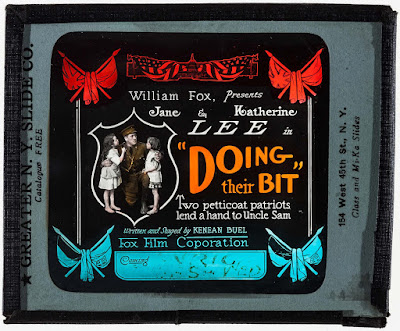 |
Glass slide for DOING THEIR BIT (1918)
|
 |
A scene from DOING THEIR BIT (1918)
|
DOING THEIR BIT afforded Jane and Katherine less screen time than the previous films, with less of the pranks they were famous for. This was also Kenean Buel's last picture with the Lee kids. Arvid E. Gillstrom would be their new director.
Gillstrom was born in Sweden in 1889, and the following year his family immigrated to the States. He tried his hand at various jobs, until he stumbled into the movie business. He witnessed a film being shot on a four-masted schooner, in which the villain was going to do away with the hero and the girl by dynamiting the mast atop which they were perched. The hero and the girl were to save themselves by diving 80 feet into the water, even as the mast was being blown. The "girl" was actually a stuntman in drag. He lost his nerve, climbed down, and quit. The director offered $300 to anyone who would make the dive. Gillstrom, who had been earning $300 a month in his previous job, pondered a moment, then took up the offer. The stuntman playing the hero gave him a few tips, then the scene was shot. Gillstrom's dive was less than perfect, but the stuntman was impressed by his boldness and athleticism, and the two formed a partnership. A scene in a later film required Gillstrom, now a seasoned stuntman, to leap 17 feet from one 10-storey building to another. He barely made it, clinging to the ledge by his fingertips. He decided that directing would be a safer occupation. Gillstrom was already known for his comedies when Fox hired him to direct the Lee kids.
 |
Arvid E. Gillstrom
|
In 1918 Fox cut back Standard's 52-a-year policy to 26, but inaugurated new programmes, including Excel Pictures, released on a bi-weekly basis. Excel pictures offered higher standards, top stars, bigger directors and better stories, saving exhibitors "the embarrassment of apologising for a production's shortcomings." They also gave exhibitors a wide variety of genres in the programme, for the more diverse theatres. The remainder of Jane and Katherine's productions were transferred to the new Excel line, and were often shown with one of Fox's Sunshine Comedies or a 7-minute Mutt and Jeff cartoon.
Their first picture with Gillstrom, SWAT THE SPY, was released September 29, 1918. Andrew Sheldon is a chemist working on a new type of explosive for the government. The girls accidentally help discover the formula by nudging their father's arm while he's mixing chemicals. The Sheldons' butler and cook, German spies, intend to steal the plans. The girls, through their mischievousness, upset them at every turn. Mrs Sheldon is pregnant, and Andrew Sheldon informs the girls that he's sending a request to God for a new addition to the family. Jane and Katherine, averse to the idea of having a baby brother, swipe what they believe is the envelope being sent to heaven, but unwittingly steal the weapon plans instead. While the family is busy with the new born baby, the spies secure what they believe is Sheldon's secret formula. Jane and Katherine overhear the plot while raiding the jam pantry forbidden to them, and, with the aid of some soldiers, pursue the spies. After a car chase, the butler tries to flee in a row boat, but is captured. Of course, the girls were in possession of the plans all along.
 |
Jane swats the spy -- with a hammer! Circular inset: the girls on the steps of the Sub-Treasury Building (see below)
|

SWAT THE SPY began shooting mid-August 1918 under the title "Go Get 'Em", and wrapped up a month later. On September 4, while Jane and Katherine were shooting scenes at the Sub-Treasury Building on Wall Street, a crowd of 3,000 gathered to watch and cheer as the girls mangled German spies in their own inimitable way. Spectators also caught a glimpse of the new posters for the Fourth Liberty Loan only weeks away.
Liberty Loan Committee members were also present at the Sub-Treasury Building the day of filming. One of them asked the girls if they would buy a bond, and the girls exclaimed that they'd trade their baby brother for a bond. (In one of the scenes in SWAT THE SPY, Jane and Katherine attempt to swap their baby brother for a bond.) The committee immediately had photos of the girls taken with a baby, and posters of Jane and Katherine, emblazoned with the line, "We'll trade our baby brother for a bond!" were displayed across the country.
Jane and Katherine's baby brother was actually a two-week old girl named Dorothy, whom the sisters became infatuated with during the two days the baby was on set. They offered to buy Dorothy, but the mother's selling price of $250 was too steep, and more so when the girls were informed that the baby clothes weren't included. Katherine cradled the baby in her arms at every chance. Jane wasn't allowed, much to her chagrin. Katherine's wish was that their mother would get her and Jane two baby brothers, one for each of them. "Oh, they wouldn't bother her any," she said. "I'd take care of them all the time."
A common mistake seen in newspaper ads was the title "Swat the Fly", but the movie did well nonetheless.
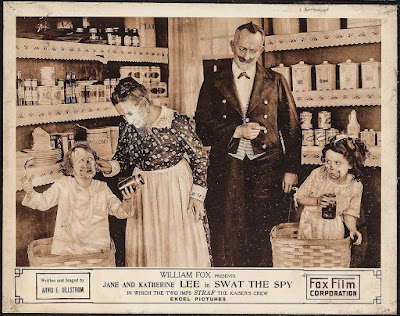 |
Jane and Katherine are literally in a jam
|
In their next movie, TELL IT TO THE MARINES, released November 17, 1918, Jane and Katherine are more impish than before, destroying their play room and almost scaring the butler to death by placing fire crackers in his pockets. They run around playing "war" with toy airplanes and toy guns, but as there are no Huns to attack, they turn their attention to their parents' guests, put dice in the minister's pocket, and see to it that everyone is soaking wet before they leave. The girls also take a miniature car for a joy ride through crowded streets, plow through a haystack and crash into a cow, from which they help themselves to a drink of milk. That night, Jane dreams about their adventures in the form of war, enacted by dolls and mechanical toys. Trik is the leader of the Allies, and Trak heads the Huns. Troops are inspected. Airplanes and zeppelins bombard a village from above, howitzers from the outskirts. Battles are fought with cannon. Scores of soldiers march through the rubble. Trak uses poison gas, and Trik uses a mobile bellows to suck it in. All manner of warfare is depicted. Jane wakes up and realises it was a dream.

 |
"Licence and registration? What's that?"
|
The dream sequence comprising the last two of the movie's five reels employed the use of stop motion animation. It's fantastic scale and detail was the result of a year's worth of meticulous planning and labour. But Arvid Gillstrom had nothing to do with it. The sequence was taken from a 1917 Italian film, LA GUERRA E IL SOGNO DI MOMI ("The War and Momi's Dream"), which had a limited release in the U.S. in December of 1917 under the title MOMI'S DREAM, and in the following summer as OUTWITTING THE HUN. In the original film, the mechanical toy war is also a child's dream, influenced by a letter from his father, battling at the front.
The credits for the film are disputed. Some contemporary accounts give sole credit to Italian director Giovanni Pastrone, whose two hour epic, CABIRIA, was an international sensation in 1914. Others credit Spanish director Segundo de Chomon, or reckon that it was a collaboration between the two, with Chomon responsible for the animation. New York producer Harry Raver imported the film for distribution, but at 40 minutes it was a hard sell, being too long for a short, and too short for a feature. Raver sold the rights to Fox, and Gillstrom inserted it into a picture without a plot. In TELL IT TO THE MARINES, Jane and Katherine had by far the least screen time of any movie in the Baby Grands series.
 |
Katherine and Jane with Trik and Trak, promoting TELL IT TO THE MARINES (1918)
|
Jane and Katherine's eighth and final feature was the only one filmed at Fox's growing west coast studio, located in Los Angeles on Western Avenue, near Sunset Boulevard. The Lees left New York on October 9 and arrived October 16. Irene had no desire to make the move, having spent twenty years in Manhattan. "I do hope I'll like it here," she said to a friend who met them at the train station. Katherine tried to cheer her up: "Never mind, mother. There's a Broadway in Los Angeles." During the taxi ride from the station, Katherine grew excited by the alien foliage: "Oh, look, mother, they have palms on Broadway. We haven't anything like that in New York."
Despite Katherine's optimism, the family was greeted with bad news: due to the Spanish flu, theatres were closed, and all movie production companies greatly reduced their activities. Production on Jane and Katherine's next movie was suspended for four weeks. They were laid off, as were the cast and crew of other Fox companies.
 |
1916: Katherine and Jane's favourite pastimes were reading the funnies and typing
|
Despite getting bit on the nose by Theda Bara's Russian wolfhound, Jane loved dogs, and at the end of October she lost her little brindle bulldog. The Lees placed an ad in the L.A. Herald offering a "suitable reward", giving the Fox studios as the address to return it. Earlier in the year while filming in Georgia, Jane disappeared while the cast and crew were boarding a train. As the train was to leave in three minutes, Kenean Buel sent everyone in every direction. At last she returned with "a pitiful looking little mongrel." She wouldn't part with the pooch, so it was taken aboard.
While filming the CLEMENCEAU CASE, Jane insisted on bringing her kitten to the studio every day. But her obsession with animals really began while she and Katherine were filming A DAUGHTER OF THE GODS. She'd brought a trunk filled with her cherished dolls to Jamaica, but forsook them when she encountered the menagerie being used for the film. Jane's requests for a pet were refused by her mother: a Saint Bernard, a baby elephant, an alligator. The toddler was understanding when it came to Jabez, the baby elephant: "Jabez weighs a lot and Mamma's afraid he'll step on me. He's a little large for a house pet and kinda unhandy." Annette Kellerman consoled Jane with a baby swan, but Irene wouldn't allow her to sleep with it. She also kept a horned toad as a pet. Her doll, Lulu, was jealous of the swan and the toad, according to Jane, and would cry when she played with them. For some reason Jane loathed the small monkey used in A WIFE'S SACRIFICE. Stuart Holmes played Peppo, a despicable villain, and Jane was livid in a scene where she had to give a coin to Peppo's monkey.
 |
Tinted version of a popular photo
|
Work commenced on the movie, tentatively titled "Keep Smiling", late in November. Jane and Katherine's father is battling at the front, and they're being looked after by the housekeeper, who is relieved when Aunt Lucille offers to take the girls. The housekeeper covers Jane and Katherine in stamps and sends them by parcel post. The postman places the girls in a sack. The housekeeper refused to pay postage for the dog, and it chases after them. Jane hides him in the bag. Their aunt takes them to Restwell, New Jersey, hoping that the excitement of the ocean will distract them from their mischievous activity. At a hotel lobby Jane and Katherine create grotesque shadows on the wall for the benefit of a guest named Al K. Hall, who is terrified. They play checkers on the lobby floor using the guests' hats, and get into more antics on the fire escape. They take an airplane for a joy ride when Katherine accidentally starts the motor. When their dog falls on one of the levers, the plane dives towards a building, but lands safely on the roof, where the girls perform more stunts. Anticipating a spanking, Jane hides a horseshoe under her overalls. Aunt Lucille is at her wits end with Jane and Katherine's pranks. She also breaks off her engagement to Captain Tom Hayes, who she believes is a slacker for having retired from the army. Tom is actually now in the secret service, developing a radio mine to blow up U-boats. The secret service is searching for a German spy known as the Gray Swan. An opera singer, Madame Yelba, and her confederate, Wagner, steal Tom's invention, and Jane and Katherine reveal her to be the elusive Gray Swan, and help capture her. When Lucille is informed that Tom is doing important work for the government, she reunites with him.
 |
Glass slide for SMILES (1919)
|
Katherine breathlessly described some of her and Jane's activity in the film: "We have stamps put on us like letters, and we get put in a mail sack and sent away in the mail, and we get grabbed by a grabber that reaches out and grabs us as the train goes by at sixty miles an hour; and we put mice in a man's hat and do -- oh, all sorts of the loveliest things!" They also get to push Kewpie Morgan, a rather large comedic actor, into a bathtub. Jane was bitten by one of the mice as she picked it up by the tail, but like a true professional she finished the scene and cried afterwards, while her wound was tended to.
If Jane thought acting was work, rather than a vacation, Katherine was of an opposite mind: "It isn't really work at all, the theatre or the movies. It's just play. We play almost like we do in real life, except we are allowed to do things we never would dare do at home. So you see it is even more fun."
 |
Katherine wasn't foolin' when she said they were grabbed by grabbers that reached out and grabbed them; if you look closely, you can see Teddy's head sticking out of the bag; scene from SMILES (1919)
|
While filming SMILES (as the movie was eventually titled), Jane and Katherine went up in an airplane for the first time, flying over L.A. It was an unplanned flight. The scene called for the girls to climb into the cockpit, and it was impossible to get them out.
Work was briefly halted in December until Jane could recover from an abscess. Filming finished on SMILES in mid-January, and it was released February 23, 1919, a month later than scheduled. Notwithstanding the airplane scene in SMILES, writer Ralph H. Spence claims to have eschewed slapstick comedy: "I have depended entirely upon situations to provide the laughs. I have studiously avoided unnatural, improbable and impossible incidents, and the only place that custard pie appears in the play is on the dining table." The film was marketed as "the first musical comedy of the screen", each scene timed to fit a popular tune, with 30 of the 130 sub-titles acting as cues for the orchestra. SMILES was one of the best in the "Baby Grands" series. It was also the last feature Jane and Katherine would appear in.
 |
Katherine and Jane, with Teddy, in SMILES (1919), their last feature, and their last film for Fox
|
In January of 1919, it was reported that Jane and Katherine's contract with Fox would expire in May, and that it would not be renewed. Fox severed ties with the girls by reason of their poor box office returns, stating that when Jane and Katherine were given their own starring vehicles in 1917, there was a big demand for kid features, but that the public response was less than enthusiastic.
Jane and Katherine related a very different story when interviewed in 1936. Their first movie, TWO LITTLE IMPS, grossed "over $1,000,000 on a total investment of $18,000. And for that we received a combined salary of $150 a week." When Irene realised how much money Jane and Katherine's movies were making, she demanded $300 a week. Fox refused, and the relationship ended. Jane and Katherine fulfilled their contractual obligations, including personal appearances and other publicity stunts, and in May Irene took the girls back to New York.
Jane and Katherine were quite mistaken about that million dollar figure, but their memory was more or less intact about their salary. Still, in 1919 the Lee girls were ranked #7 in the top money making stars annual poll for the previous year's box office receipts, gleaned from exhibitor reports published in the "What the Picture Did for Me" section of Exhibitors Herald magazine. Five of Jane and Katherine's eight movies were released in 1918, so Fox wasn't being forthcoming in claiming that the reason for not renewing the contract was that the Baby Grands weren't performing well at the box office.
Another $150 a week doesn't seem unreasonable. Aside from their acting work, Jane and Katherine were kept constantly busy promoting their Fox movies, with innumerable personal appearances on stage and at benefits, balls, parties and other events around the country. And somehow they managed to find time to sell war bonds and perform at benefits for soldiers. Those little girls deserved better treatment from Fox.
 |
Jane and Katherine, with Gillstrom; they weren't all SMILES in this photo, possibly because they knew the end was near
|
An interesting article was published in Variety in 1918, ostensibly a review of WE SHOULD WORRY, but a criticism of Fox's failure to see Jane and Katherine Lee's talent and potential. The writer wondered how Fox, who "is acknowledged to know his business...does not take them away, give them the attention they deserve and develop the Lees into a kidlet attraction through booming and billing that no other kids could breast.
"These Lees are not a Chaplin, Pickford or Fairbanks, to be copied or imitated -- they are just freak babies -- freaks, because they have extraordinary sagacity, unparalleled precociousness (for their age), unexampled intelligence for ones so young in the work they are performing, and a natural ability that could never be instilled in kidlets of their size and years if it weren't a gift.
"They are a certain proposition. Fox, his directors, scenario writers, and the rest of the Fox staff, may either or all say they contribute so much to any feature the Lee kids are in, but they are all wrong. They do nothing. The Lees do everything, for the Lee children have everything all their elders could not possibly have when it comes down to performing in a picture.
"They are great kids, the greatest and most genuine actors before the picture camera of the present day. They are young, innocent, pure, untouched by vanity or ambition, naturally natural, and could be exploited into the most certain drawing card an exhibitor could have."
As soon as the Lees arrived in New York, Jane and Katherine performed at the Elks Lodge No. 1, on West 43rd Street, near Broadway. A number of other acts entertained the members of the private club, including Hoey and Lee. It may have been the only time Jane and Katherine were on the same bill as their namesake. In July, Hoey and Lee performed together for the last time.
On May 22, 1919, Jane and Katherine Lee formed their own film company, signing a one year contract with Louis T. Rogers. Rogers had been a sales manager for the Fox Film Corporation since its inception, quitting in the fall of 1916 and subsequently suing for $1800 owed for extra work as Canadian sales manager. Lou's brother, Gustavus A. Rogers, a well-known lawyer in New York, had been William Fox's business partner in their theatre days. The law firm Rogers and Rogers (Gustavus and another brother, Saul), were Fox's long-time attorneys. One wonders if they recused themselves from their brother's case against Fox, assuming their services were even needed for the trial. Following his departure from Fox, Lou worked in similar sales capacities for Lewis J. Selznick, followed by the Famous Players-Lasky Corporation, the latter of which he quit to form the independent Rogers Film Corporation, confident in his ability to make the Lee sisters an even greater phenomenon than they had been at Fox.
 |
Fox had his "Baby Grands", Rogers had his "Infant-ry"; early ad, June 1919
|
 |
Another early ad, from Exhibitors Herald, August 2, 1919; the drawing hints at what's to come in their first Rogers release, THE CIRCUS IMPS (1920); the human skeleton, the bearded lady (riding the camel) and the fat lady are some of the "freaks" in the film
|
The plan was to produce a series of twelve 2-reel comedies, released one per month. "It was after much consideration that we decided to make two-reelers," Rogers said in a statement of his intentions, "as after a personal campaign to the exhibitors all over the country, and we based our plans on their replies." The pictures would be brief enough to allow Jane and Katherine to "carry on throughout the picture with a snap and vivacity which an offering of greater length would make impossible..." He also proudly proclaimed that they were giving these 2-reelers "as much attention, work and material" as they would a 5-reel feature: "In story selection, direction and general treatment of production no pains or expense are being spared to make of the Lee playlets an attraction as unique and different from the general class of comedy as the young principals are themselves unique among motion picture stars." Rogers promised "a happy medium of comedy and plot". The idea was "proving especially popular with exhibitors", who "from all quarters of the country have wired or written to be listed as applicants for the series as soon as same shall be released. Not a few applicants have pointed out that the 'Lee Kiddies' are well and popularly known in their district, in many cases having appeared personally on their stages."
 |
Expensive 4-page insert from Motion Picture News, August 30, 1919; Rogers swiped all the pics from Fox
|


Fan mail had been pouring in since it was announced that Jane and Katherine would no longer be working at Fox. The girls couldn't possibly answer their queries personally, so they had postcards made up, with their picture in a medallion, accompanied by their signatures, and a statement of their future plans. Exhibitors also wanted to know when their next film would be ready. Rogers finally announced a date: September 1, 1919.
Their first movie, which started filming mid-June at the Erbograph studio in Fort Lee, had the bizarre working title of "Freaks in Oil". Playwright Phillip Bartholomae wrote the story. Charles Harbaugh was set to direct, but was replaced by Tefft Johnson, a stage and screen actor. Johnson was known for his work with children, having directed the "Sonny Jim" series of one-reelers for Vitagraph in 1914 and 1915. Bobby Connelly played the title character, with Johnson in a supporting role as his father. Johnson started his own short-lived company, the Tefft Johnson Film Corporation, producing and directing three "Sonny Boy" comedies. Sonny Boy was played by Willie Johnson (no relation), with Tefft Johnson as "Daddy Dear", and Mabel Kelly as "Mommy Dear". These one-reel plays were all too familiar, and the prospective "one a week" series never took off. Tefft Johnson then joined Fox's stable of directors, before moving on to World Film, where he directed another child star, Madge Evans.
 |
Director Tefft Johnson
|
On the first day of shooting, children gathered outside the studio, clamouring to see Jane and Katherine at work, their efforts thwarted by security. Jane and Katherine play the daughters of Tom Lee, who manages the freak show at a circus, which included George Dowling, the British giant, a clown, a living skeleton, a fat lady, a bearded lady, a dwarf, a dog-faced boy, and others. The film also involved oil wells. The fitting but injudicious working title, "Freaks in Oil", was dispensed with, as CIRCUS IMPS was decided upon.
Katherine was especially excited about the new series: "We're going to make two-reel comedies, you know," she told an interviewer in June, "and Mr Rogers says we'll be able to know how people like them in three months. I hope they like them because we love to make them. We think they're going to be very good -- at least, we're trying awfully hard to make them funny."
 |
Another expensive 4-page insert, from Motion Picture News, September 13, 1919; Rogers was still using old photos from Jane and Katherine's Fox films
|


So confident was Irene Lee in their latest venture that she bought a new Lexington, which she used to drive the kids to the studio. Rogers was just as optimistic, and began an advertising campaign unprecedented for 2-reel shorts. He placed 4-page inserts in the popular trade magazine, Motion Picture News. As Fox had advertised the girls as the "Baby Grands", so too did Rogers come up with a nickname for his two little stars: "The Infant-ry". Where that pun originated is hard to say, but it was used in 1918 when Private Irving Berlin arranged the entertainment for the soldiers at Camp Upton, of which Jane and Katherine took part. In introducing the Lee kids, stage actor Grant Mitchell said, "And now, as this is truly a military affair, I take great pleasure in presenting the infantry." Rogers promised much more: tie-ups with products, to be advertised nationally; billboards; and even electric signs in the best spots money could buy.
Things were moving at a rapid pace. They finished CIRCUS IMPS early in August, and immediately began work on their second film, DIXIE MADCAPS, which had a handful of working titles with the word "Dixie" in them. Once again, Tefft Johnson directed and Philip Bartholemae wrote the scenario. While Jane and Katherine were busy filming, CIRCUS IMPS was being cut and titled, the release date fast approaching.
During the filming of DIXIE MADCAPS, Katherine and "Mr Rogers" played a trick on Jane, to get her riled up for a scene in which Jane strikes her sister with a whip. Katherine told the story a few days later: "It wasn't in the script at all, but when she hit me, instead of walking out as she expected, I turned on her and smashed her hat down over her eyes and told her just what I thought of her, and all the time the camera was grinding and Mr Rogers and Tefft Johnson, our director, were laughing, and Jane didn't know that she was working. She thought I was quarrelling with her." Jane had something to say about it: "Well, I don't care, no one will know that when they see the picture. They will merely think that I am a good actress. And I think that is the desire of all actresses -- to be thought good."
It wasn't the first time Jane was tricked into getting emotional for the camera. In 1915 Herbert Brenon told the three-year-old he didn't love her anymore and would replace her with another little girl. She burst into tears.
 |
Jane and Katherine greet race car driver Ralph De Palma, 1919
|
Katherine described an average work day: "We get up at seven o'clock, report at the studio at 9, work until lunch hour, then run up to our rooms, where it is nice and cool. The studio lights are very annoying, you know, and give a terrible heart, so we are glad to escape to our rooms at noon. Then we have a ham sandwich and huckleberry pie." They work again till five o'clock, then go home.
Strange that Katherine would say "we have a ham sandwich", considering Jane was vegetarian, something Irene instilled in her. Katherine confirmed Jane's diet in an interview conducted at a restaurant during the filming of DIXIE MADCAPS: "I shall have some cold consomme and some roast lamb with mint sauce, and Jane will have some baked bluefish. She doesn't eat meat." Jane's favourite was noodles, and though she rarely ate candy, she could stuff herself with dessert. When filming SMILES, cakes were ordered from a restaurant for a banquet scene. Afterwards, when most of the cast and crew had vacated the set, Jane devoured the cakes, as well as some peach pie and gooseberry jam.
Jane admitted that making CIRCUS IMPS was "lots of fun", and that their new 2-reelers were "awfully funny. We get to laughing over them all the time when we're working."
Unfortunately, something went wrong. Lou Rogers found himself a little financially embarrassed. He couldn't finish DIXIE MADCAPS, nor could he pay Jane and Katherine their due salary. Rogers' edict, that no expense shall be spared, was his undoing. Aside from the advertising blitz, he contracted future stories from well-known authors, for which he paid top dollar. He rented studio space at Erbograph and Solax in Fort Lee, and a studio in Yonkers. Exteriors for DIXIE MADCAPS were filmed in Long Island, and in Georgia, for some genuine southern atmosphere, as called for by the story. In CIRCUS IMPS, they filmed at Oil City and the Bradford oil fields in Pennsylvania; in Woonsocket, Rhode Island for a week with the Sells Floto Circus; and for a scene calling for the christening of a ship at the Newark shipyards, Rogers could have used a bottle filled with water, but paid for an expensive bottle of champagne instead, to make it "authentic". Rogers had his film crew get rid of whatever equipment they were using, and buy state of the art cameras. Nothing was too good for his two little stars.
 |
2-page insert from Motion Picture News, September 27, 1919
|
September 1, 1919 came and went, without the release of a new "Baby Grands" or, rather, "Infant-ry" movie. That month, Irene lent Rogers the money to finish DIXIE MADCAPS. She summarily resigned from her position in the Rogers Film Corporation, perhaps acutely aware that the ship was sinking. Rogers didn't give up so easily. In October, a third picture was in pre-production. Skating was involved in the plot, with stunts and acrobatics, and Jane and Katherine were undergoing a rigorous training from a "well known expert". Their movies at Fox required them to do stunts, and Irene always made sure the children did a half hour of exercise every morning, as soon as they got out of bed. The third picture was never filmed.
What happened next was a mess. Lou Rogers gave Jane and Katherine's contracts to the United Picture Theatres of America, a cooperative with numerous exhibitors; in exchange, United Pictures agreed to pay the cost of production for DIXIE MADCAPS, which amounted to $25,939. (If TWO LITTLE IMPS, a 5-reeler, cost $18,000 to make, as Jane and Katherine later recalled, then $25,000 for a 2-reeler seems reckless.) Irene Lee sued Rogers for her daughters' salaries, and for the money she lent him to finish the second film. She won and the contract with Rogers was cancelled. In April, 1920, Tefft Johnson sued the Rogers Film Corporation for $3200 in back pay, but the papers were served to Irene, who had resigned in September. Rogers denied the charges, and filed a counter claim, alleging that Johnson, who was paid $400 a week, was so inept as a director that the Lee kids movies weren't fit for public exhibition, and that they had to spend $700 to improve them. Rogers also sued United Pictures for $12,380 still owed on their contract.
Rogers was bankrupt, and the two films were shelved. Vague movie offers came and went. It seemed Jane and Katherine's screen careers were over. But there was still one recourse: vaudeville. With Irene's experience and management, they stood a good chance. She hired an agent who dealt in small venues, and the girls began their vaudeville career in October of 1919. "The children started off as a bad act," wrote one contemporary columnist. But their shows were well received outside of New York City, and word of mouth created a demand. Jane and Katherine were earning $300 a week, the amount Fox refused to pay them. Their luck improved when Thomas J. Gray wrote a sketch for them.
 |
Tommy Gray
|
Tommy Gray, who lived in the same New York neighbourhood all his life, was a humourist who started off writing lyrics for musical comedies, then titles for movies. For many years he had a column in Variety, "Tommy's Tattles", which appeared regularly when he was in New York, sporadically when away. But his specialty was writing one-act plays for vaudeville. His witticisms were never-ending. Variety commented, "Epigrams famous writers would have striven for for months were uttered and immediately forgotten by Tommy Gray as merely necessary to the occasion he might be presiding over." Recognising Jane and Katherine's exceptional talent, he wrote "The New Director" for them. He also fought for a higher salary for the girls. Theatre managers couldn't see why they should pay the Lee kids $1000 a week when they were already performing for $300. Gray was insistent, and after managers saw the act for themselves, $950 was agreed upon.
"The New Director" opens in one (the front part of the stage with the curtain directly behind them), the girls engaged in a humorous dialogue about movie studios, and the "warm reception" they have planned for their hapless new director. The act switches to full stage, a studio setting, with cameras. William Phinney, often performing anonymously, played the "shouting, stampeding director". An extra was used as the cameraman, panned by at least one critic: "Some one should tell the camera man that a moving picture is turned two turns to the second and not at the funeral speed he took today." Jane is directed to dive into a jar of jam, which she smears on her face. She then walks to the footlights and tells the audience, "We actresses suffer so much," perhaps a reference to the jam the girls smeared on their faces in SWAT THE SPY. The scene switches to a rehearsal, in which Jane weeps at Katherine's deathbed. They return to comedy, the girls depicting two old maids at a movie theatre, commenting on the picture.
On stage, as in the movies, Jane generally did the clowning, while Katherine played the straight. Jane was also skilled at comedic ad-libbing, and the act would stop occasionally due to Katherine and Phinney's uncontrollable laughter. For this reason, their 20-minute act would vary in length by a minute or two. At Gray's insistence, some of Jane's bits were kept in the act. Gray, who took the girls under his tutelage and management, had a hard time writing the deathbed scene, but he wanted to prove that Jane was also good at drama. Jane's convincing performance in this scene was by far the most commented upon part of their act. There was nary a dry eye in the house.
 |
Newspaper ad, 1921
|
One writer remarked that the Lee girls "both display exceptional vocal training, their speaking voices being loud, clear and heard distinctly in all parts of the house, something unusual in child performers." Another thought the girls were magnificent performers, but that Gray's dialogue was too sophisticated, that it detracted "somewhat from their cuteness to hear kids of their age springing lines and gags that should come from old heads."
"The New Director" was a tremendous success with both patrons and critics, and Jane and Katherine were now topping the bill. They were booked solid for 17 weeks in and around New York. "Size don't count, so long as you deliver the goods," quoth Jane.
In May of 1920, Irene Lee responded to a letter sent to Billboard asking why her 12-year-old child wasn't allowed to appear on the stage, but Jane and Katherine were. Irene assured her that the laws were the same in all states, but that children were only prohibited from singing and dancing on stage:
"I have to go and get my permit every Saturday morning, and I think in all fairness to myself and my children the facts should be stated, for I don't want anyone to labour under the impression that any favouritism is being shown. The children do a twenty-minute act twice daily and this the law allows. They also attend the Professional Children's School, which closes this month, and during the summer our governess will look after their education.
Jane and Katherine toured the U.S. and Canada with their act, and while on the road did their lessons by correspondence. William Fox had always made sure that Jane and Katherine and other juvenile stars in his employ received some form of education, be it at home, school or at the studio. The Lee sisters were tutored, sometimes by nuns. In New York the girls were prohibited from performing on the stage in July and August, the summer holiday from school, though they were still allowed to do film work, if the opportunity arose.

Despite not being seen on the silver screen for over a year and a half, Jane and Katherine's celebrity hadn't waned. They, along with Tommy Gray, were the guests of fighter ace Eddie Rickenbacker, who took them for a ride in a Larsen monoplane, taking off from Central Park, Long Island. They enjoyed their first flight in a plane during the filming of SMILES, but not so this flight. While it's doubtful Rickenbacker displayed any of the dogfighting manoeuvres he was famous for with the girls aboard, they were obviously uncomfortable. When they reached an altitude of 3000 feet Jane felt sick. They kept going higher, 6000 feet, according to Katherine: ""We ought to be seeing angels soon; think we'd better get back to earth, Mr Ace. Don't you think so, too, Jane?" The girls were relieved to return to terra firma. "Well, we've been up and we know now 'how far is up'," said Katherine. "Mr Rickenbacker certainly was the darlingest man in the world and he brought us back without a scratch. I liked it, but think I would rather be entertained on earth than in heavenly regions, just now." Jane was asked who her favourite hero was: "Well, I can't just decide between Eddie Rickenbacker and Ralph De Palma. They both go so fast, it takes your breath away. It's smoother going up in the air with Captain Rickenbacker -- until you hit an air pocket. Then it seems to me it would be nicer to be with Mr De Palma in his big racing car."
The girls were precocious, as would be expected from two children who had been so prolific and productive on screen and stage and in their wartime activities. Katherine was asked how long she'd been in movies, and though only ten gave a jaded answer: "Oh, I don't remember. I don't care to remember. It seems a hundred years, and perhaps it is, and Jane and I are in our second childhood. You know, the first hundred years are the hardest." Katherine was careful about what she told reporters, and when their manager held a press conference at his office in October of 1919, she advised them to pick and choose from her answers and statements, so as not to write stories that were too similar: "That will never do, for each one of you to write the same thing. You must each write something different." In a separate interview, 8-year-old Jane had some advice, too: "No matter what your job is -- if you're earning fifty dollars and getting ten, it's because you aren't selling yourself. You're not making other folks 'get you'."
By September 1920, Jane and Katherine were earning $1500 a week -- ten times more than Fox had been paying them. They were less enthusiastic about the stage during their earlier months in vaudeville, preferring movies. Every day there was something new to do in motion picture work, but doing an act on stage could get monotonous. Irene summed it up: "In vaudeville they see the same people and the same things every day." Jane added, "Yes, we see Tommy three times a day." Katherine preferred pictures: "Vaudeville is all right, but when we are working in pictures we can live at home, and we like that much better than so much travelling."
By 1921 the girls were of an entirely different opinion:
Katherine: "We have found that playing before an audience is a real inspiration..."
Jane: "Yes, after having some director boss you around and no audience at all..."
Katherine: "And we love to hear the applause..."
Jane: "Now, and not six months after we have acted."
Good news came for fans of the Lee girls: CIRCUS IMPS was finally released in October of 1920. The comedy short was being distributed by the Masterpiece Film Corporation, only recently formed, with Lou Rogers as vice-president. Masterpiece was a distributor of independent films, and the picture was sold slowly, territory by territory, starting with New York, New Jersey and Connecticut. Jane and Katherine may have been headliners in vaudeville, but CIRCUS IMPS was just an "added attraction". They were no longer movie stars.
In CIRCUS IMPS, the Lone Star Circus comes to Farmingdale, Texas, the home town of Tom Lee, who owns the sideshow of freaks. Tom's daughters, Jane and Katherine, are excited, but the circus does poorly, as the entire town has invested their money in the oil boom. The owner of the circus, Jack Grimes, sells the company to invest in a well, leaving Tom and his sideshow out of work. Jane and Katherine decide to help their father by putting on their own show with the freaks. The patrons are mostly children, and Jane and Katherine earn only a handful of change. Grimes discovers that his well is dry. The girls drive a stake in the ground to tether their goat, and a gusher of oil spouts, shooting the goat in the air. Tom, Jack Grimes, and the freaks try to stop the flow, but only succeed when they place the fat lady over the gusher. The circus folk become wealthy.
 |
CIRCUS IMPS (1920)
|
 |
CIRCUS IMPS (1920)
|
December saw the release of DIXIE MADCAPS. Two little ghosts pop out of large watermelons in the patch, scaring the black plantation workers, who were enjoying a watermelon eating contest. They scatter in every direction. One of them is so scared he turns white. The ghosts reveal themselves to be Jane and Katherine ("Pride of the Plantation") wearing sheets. Everyone is relieved that it's just another of the little girls' pranks, and they all dance to the banjo and drum. On Sunday, Colonel White, grandfather of the orphaned girls, gives each of them a nickel for the collection plate and sends them off to church with "Old Mammy", who is constantly tormented by their mischief. Ditching Mammy, the girls spend their nickels on ice cream cones, and Jane finds a little mutt that gets her Sunday dress and stockings all muddy. On the way to church, Jane and Katherine surreptitiously "confiscate" the money and dice from some gamblers while they're being rebuked by Parson Brown. The girls smuggle the dog into church and take a seat. Jane places one of the dog's fleas in the collar of the man seated in front of them, and he begins scratching himself. The girls put the gambling money and dice in the collection plate. Jane chews gum in church and they thumb their noses at the preacher when he discovers their dog. He has the girls hauled off to their grandfather, but they knock the man down and laugh as their dog chases him away. Grandfather has had enough, and tells the girls he's sending them to their aunt in New Jersey, who plans to place them in a boarding school.
Their protest, "What have we done to be sentenced to New Jersey!", seems almost to be making fun of Fort Lee, much as their vaudeville act lampooned the studios. Their closing speech at the end of the New Director begins, "Ladies and gentlemen and moving picture friends...", mocking celebrities.
 |
Ad from Exhibitors Herald, January 29, 1921...but where did that third movie come from?
|
 |
Not re-issues...if they haven't played in your neck of the woods, yet. Lower left: Jane playing with her chewing gum in church
|
DIXIE MADCAPS was the last of Jane and Katherine's films -- at least as a duo. Or was it? In January of 1921, Masterpiece started advertising the impending release of a third movie, THE HICKSVILLE TERRORS, said to be a sequel to DIXIE MADCAPS. There was just one problem: the girls never filmed a third movie for Rogers. It became clear that HICKSVILLE TERRORS was assembled from discarded footage from the first two movies. Irene and her lawyers were in court that month, questioning the right of Masterpiece, the distributor, to create a movie from scenes left on the cutting room floor, especially as it was done without her knowledge or permission.
The legal case was unprecedented, and knowing that it might take a long time to resolve, Irene wasted no time placing a full page ad, dated January 12, 1921, in trade magazines, protesting HICKSVILLE TERRORS and asking exhibitors not to show the film:
"(1) Because the picture is injurious to the name and reputation of the Lee children, as it is made solely of material that was discarded in the first two pictures.
"(2) Because the release and distribution of this picture as a picture made by the Lee children is unfair to the exhibitors and moving picture patrons who are attracted by the work of the Lee children."
As an injunction wouldn't be granted anytime soon, Irene sought to appeal to exhibitors on ethical grounds. It didn't work, and HICKSVILLE TERRORS was released in February.
In the film, Colonel White sends Jane and Katherine to their aunt, Hannah Green, in Hicksville. The girls switch their tag for one with a crate of chickens being sent to their aunt's neighbour. The children are sent to Mr Grey and the chickens to Aunt Hannah. The Colonel comes to Hicksville to straighten things out.

That same month Harry Lee had to answer to the V.M.P.A. (Vaudeville Managers Protective Association) for being advertised as the father of Jane and Katherine Lee. Harry denied any knowledge or involvement in the erroneous publicity. The complaint may have come from Irene. On February 28, 1922, Charles Hoey suffered a brain hemorrhage, and died at Bellevue Hospital in New York on March 7.
On May 30, 1921, Jane and Katherine were in Washington, D.C., headlining at Keith's. President Harding and his wife were in attendance, along with a few friends. After the show a crowd built up outside, waiting for the president to emerge. Jane and Katherine were determined to meet him, and quickly wiggled their way through the crowd with their mother and manager, until they came to the fore. Harding recognised the two girls, and immediately went over to them to shake hands, and to express his gratitude for a wonderful performance. Later, the girls each received a personal invitation to the White House, where the President presented them with an official souvenir programme, specially printed for his visit to Keith's, which he autographed. The girls were photographed with Harding's Airedale Terrier, Laddie Boy.
 |
1921: Jane and Katherine often received bouquets of flowers from admirers after a show; they'd have them sent to children's hospitals, where they also performed countless times for their bedridden little friends
|
In June of 1921, Irene filed a lawsuit against Harry Linke, an actor, for slanderous statements he made April 8 in Syracuse, New York to the Society for the Prevention of Cruelty to Children. He claimed that Jane and Katherine were "treated roughly and abused both in their act and off the stage. She compels them to rehearse at night until the early hours of the morning. I have heard those children cry on account of the abuse they have received from their mother. Her treatment of them was so bad I left her employ." The Society conducted an investigation. Irene denied the accusation, calling it malicious, and an attempt to prevent the girls from performing on stage. She was asking $10,000 in damages. Linke denied any motive other than concern for the children's welfare, and asked that the case be dismissed with costs.
It wasn't the first time the children's punishment made the news. Soon after their arrival in L.A. in 1918 to film SMILES, Jane pushed Katherine into the fountain at the Fox studio, then got soaking wet herself. She received "her first California spanking."
It wasn't the last time either. In January of 1922, Irene and the girls were taken to the police station after railroad personnel complained that she was "punishing Jane too severely." She explained that the girls sometimes got out of hand, resulting in five or six spankings a year. Some of Jane and Katherine's fellow vaudevillians assured the police that they received the best of treatment from Irene. She dried the girls' tears and they were allowed to leave.
 |
On the Orpheum tour, 1921
|
In the fall of 1921, Irene finally gave up their Manhattan apartment. "Since the children began their stage career, two years ago, we have been from the Eastern to the Western coasts, but we have kept the same apartment we had while they were doing pictures. In fact, they can scarcely remember any other home. Even though we're not there very much, it's a home, a place to come back to, and a place to leave things that we can't carry around with us." Famous Players-Lasky had just opened a studio in Astoria, Queens, and it was rumoured that another studio would be opening in Bayside, Queens. Movie stars were flocking to Bayside, and in September Irene purchased a renovated ten-room stucco house, with all the latest modern conveniences, overlooking Little Neck Bay. The Lees didn't move into their new $25,000 home until late November, as they were on tour, now on the Orpheum circuit.
Eventually, they reached California, where Jane and Katherine were back in a Willys-Knight automobile -- this time in the driver's seat. The girls were taken for a morning drive in Los Angeles, guests of the manager of the company's local branch, when Jane immediately grew enthusiastic: "Mother, I actually must sit in front." But that wasn't enough: "I actually must steer this car." It was an outrageous request, of course, but the 9-year-old was relentless. She was allowed to drive it on Wilshire Boulevard, her feet barely reaching the pedals, but she found the steering a breeze. Irene sat beside her, guiding her every movement. Katherine, being older, was quite justified in demanding her turn. At this stage, she was slightly shorter than Jane, but drove with just as much success.
 |
"I actually must steer this car." Jane takes the wheel of the Willys-Knight, Sheepshead Bay Speedway, 1917
|
In December, Jane and Katherine, accompanied by Ira Gay's orchestra, gave a concert on the roof of the 5-storey Hamburger's Department Store in Los Angeles. The performance was broadcast over a thousand mile radius by students of the radio phone class, conducted daily on the roof. The audience would have been small, radio broadcasting being in its infancy. No doubt it was the girls' first time on radio.
Tommy Gray, on vacation, stayed with the Lees in L.A. over the Christmas holiday. Jane and Katherine gave a Christmas party at the Orpheum on December 24 for more than two dozen children of the screen, with Gray as master of ceremonies. Among those invited were Jackie Coogan, Baby Peggy, "Sunshine" Sammy and Jackie Condon, the last two soon to be members of Our Gang.
 |
Newspaper ad for Jane and Katherine on the Orpheum circuit, 1922
|
In April of 1922, Irene bought another 50 feet of property next to their Bayside home, and had a landscaper improve it. The Lees were rarely there.
The following month Jane and Katherine, baseball fans, had the honour of presenting Babe Ruth with a diamond-shaped floral display at the Polo Grounds on behalf of the National Vaudeville Artists. Ruth was a member of the N.V.A., having played the Keith circuit in a sketch written for him by Tommy Gray. Irene and Tommy were also on hand for the ceremony.

Peggy Brown, part of the cast of "The Passing Show", an annual musical revue produced by the Shuberts, gave Jane and Katherine her dog. They lost the little Pekingese spaniel two months later, but it was restored to their home in Bayside after they placed an ad in the paper. Misplacing pets was becoming a habit with them.
The girls premiered a new act at the beginning of August, "The Movie School", written by Tommy Gray. They were back on the Keith circuit.
Concurrently, Fox released A PAIR OF ACES, the first of five two-reel shorts that were edited from their features, with new titles by Ralph Spence. KIDS AND SKIDS, DOUBLE TROUBLE, TOWN TERRORS, and THE WISE BIRDS followed, released one a month. Apparently, the Lees lost their case against the Masterpiece Film Corporation, allowing Fox to release "new" comedies by the Baby Grands.
 |
Jane and Katherine, 1923
|
Early in the spring of 1923, Irene sold their Bayview house and the Lees moved to Hollywood, where the film industry was booming.
On July 28, Jane and Katherine left New York for England on the steamship Leviathan, under a six week contract with Oswald Stoll. Their tour began in Liverpool. They performed their "New Director" act, since it was unfamiliar to the British. The tour went well. Of course, Irene went with them, but by now 14-year-old Katherine was starting to make business decisions, and Jane deferred to her judgement, having looked up to her since the days when Katherine buttoned up her coat.
 |
Jane and Katherine aboard the Leviathan, 1923
|
 |
Jane and Katherine on tour with the Greenwich Village Follies, 1923
|
On October 22, Jane and Katherine joined the "Greenwich Village Follies" as headliners at the Apollo theatre in Chicago. They toured with the annual revue for a few months, performing their vaudeville act in the spectacular 24-scene, three hour show. In Dayton, Ohio, state law prohibited the kids from performing. Irene filed a complaint with the Actors' Equity Association, stating that the producers of the show, The Bohemians, owed them $1000, even if the girls didn't appear on stage. The matter was later settled through the Arbitration Society of America. Irene lost, as the Bohemians weren't responsible for state law.
Lou Rogers, who had quit Masterpiece, became president of Rialto Productions, through which he continued to release CIRCUS IMPS, DIXIE MADCAPS and HICKSVILLE TERRORS. He resigned in November of 1922, and the contract was later assigned to Samuel R. Reece of the Rialto Film Exchange, without authorisation. In May of 1924, the R & L Film Corporation, who held the copyrights, was granted an injunction against the further distribution of the three films, and the original contract of October 22, 1922 between R & L and Masterpiece was annulled and cancelled. Existing copies of the films continued to be exhibited until they fell apart.
 |
Katherine (left) and Jane in a portrait from the N.V.A. 1924 souvenir book
|
Katherine, sans Jane, appeared in THE SIDE SHOW OF LIFE (1924), a feature film based on William J. Locke's novel, "The Mountebank". The movie was produced and directed by Herbert Brenon. It must have been a bitter-sweet reunion, since Brenon couldn't seem to find a role for Jane. It was Katherine's first time in front of the camera in five years.
On November 30, 1924, Tommy Gray died at the age of 36. Tommy had been ill with pneumonia, confined to his Hollywood apartment for 14 weeks. Unmarried, Gray returned to New York and died at the family home where he usually lived, surrounded by his mother, stepfather, siblings and friends. He kept in good humour, even on his deathbed. Five days before his death he said to the priest: "Father, on your way to the church stop in and give my regards to Tom O'Brien. Say I'll be with him very soon." Tom O'Brien was the local undertaker.
Rosetta and Vivian Duncan, who had themselves been children of the vaudeville stage, debuted their new musical comedy, "Topsy and Eva", in San Francisco in July of 1923. Loosely based on Harriet Beecher Stowe's popular book, "Uncle Tom's Cabin" (1852), the script was written by Catherine Chisholm Cushing, commissioned by the Duncan sisters. Vivian played Eva, while Topsy was portrayed by Rosetta in blackface. The songs were written by the Duncan sisters. The show was a success, and a second production was needed due to overwhelming demand. Jane and Katherine Lee made their debut in the title roles at the Selwyn Theatre in Chicago in September 13, 1925, replacing the Duncan sisters in a special matinee performance, before taking their version on the road. They were paid $600 a week, to be increased to $1000 a week starting January 6, 1926.
A month later, Jane and Katherine gave notice that they were quitting. According to Irene, it was for breach of contract, adding that her daughters "never got one word of praise from the Duncan sisters." The real problem, however, occurred two weeks later when Irene tore up a sign in the lobby of the Brandeis Theatre in Omaha because Jane and Katherine's names weren't as prominent as the Duncan sisters' names. This, she claimed, was another breach of contract. The sign apparently caused some confusion, as most people attended the show expecting to see the Duncan sisters. Irene was also reportedly jealous that dancing siblings, Jules and Josie Walters, were getting more applause than Jane and Katherine. The Lee girls were replaced by the White Sisters, who had briefly stepped in for the Duncan sisters near the end of their San Francisco run. The show moved on to Lincoln, Nebraska. For some reason the usually proud Irene regretted her actions: "I'm taking all the blame. I'm willing to play the part of the bad stage mamma. I'll even promise to stay in Omaha and let my daughters go on with the show." It was too late.
Jane and Katherine returned to their own vaudeville act, which now included two songs from "Topsy and Eva", as well as some of Topsy's dialogue. The Duncan Sisters sued. It was Jane and Katherine's contention in court that they were only doing an imitation of the Duncan Sisters. They were prohibited from using any of the "Topsy and Eva" material.
 |
Jane (left) and Katherine in a portrait from the N.V.A. 1925 souvenir book
|
In 1926, the Lees were again living in Bayside, Queens. Jane and Katherine had a new act "in one", containing only dialogue and song. One of the songs was "Sweet Onion Time", from "Topsy and Eva". The girls either obtained permission to use one song, or they were being rebellious.
On June 14, the Lees placed an ad in a local newspaper. This time they lost two dogs:
"$50 REWARD. TWO BOSTON BULL DOGS, ONE BROWN, OTHER BLACK AND WHITE, STRAYED FROM BAYVIEW AV., BAYSIDE. PROPERTY OF JANE AND KATHERINE LEE. PHONE BAYSIDE 1130."
Jane and Katherine appeared in their first talkie, a one-reeler for Vitaphone Varieties, using the sound-on-disc process. The short was filmed in California in September of 1927. The girls appear in front of the drapes, talking and singing "Tie Me To Your Apron Strings" and "All God's Chillun Got Wings". They were paid $500.
 |
Katherine and Jane, 1928
|
On February 2, 1928, Irene had her day in magistrates' court, with a charge of petty larceny against a fellow named Arthur B. Conkwright, who leased part of her house in October of 1926. She alleged that when Conkwright moved out in November of 1927 while the Lees were on a vaudeville tour he took a Windsor chair worth $20 and a dozen light bulbs worth $5. During cross-examination, Irene denied harassing Conkwright with phone calls demanding he pay the coal bill and other bills. Irene wasn't helping her case when she told Conkwright's lawyer, "In fact, if my recollection is right, I think you told me to go to hell when I was over in the Ridgewood court." The magistrate dismissed the case, declaring it a matter for civil court. "You'll get your civil action," Irene said to Conkwright as she left.
Later in 1928, Fox Movietone News filmed (with sound) Jane and Katherine at a pet show in New York, where they displayed their pets, Angel, an ocelot, and Buster, a chimpanzee. The two animals obviously weren't the best of friends.

Tommy Banahan died April 24, 1929, and the funeral was held on April 27, under the auspices of the N.V.A. Jane and Katherine postponed some of their vaudeville engagements.
On July 22, 1930, Joe Mendi, a chimp made famous by his trainer, Lew Backenstoe, died. Joe had for ten years appeared on the vaudeville circuit, as well as at circuses, fairs and in films. Irene Lee sold Buster to Backenstoe for $1000, to be paid in weekly installments of $100. Backenstoe failed to keep his end of the bargain, and Irene sued after a detective agency she hired tracked him down to a department store in Indianapolis, where he was exploiting Buster as "Joe Mendi II" in the children's toy section. They came to an arrangement. Buster died at the Detroit Zoo in 1934.
 |
Jane and Katherine, 1931
|
In August of 1932 Jane and Katherine split. Jane went west and began rehearsing for Fanchon and Marco's version of Ziegfeld's 1928 Broadway musical, "Whoopee!" The original ran for a year, and was followed by a filmed version in 1930. Eddie Cantor, who played Henry Williams on stage, reprised his role for the screen. Fanchon and Marco's condensed version of the show ran one hour and twenty minutes, retained the best parts of the original production, and borrowed costumes from the movie. Buddy Doyle, Cantor's understudy, who never got the chance to perform, starred as Henry. Mary, his nurse, was played by Jane, who was one of the leads in a cast of 65, which included 30 dancing girls and a male chorus of 12. They did four shows on opening day, not ideally attended due to incessant rain. But early reviews were good, and the show could only improve. Variety wrote that Jane Lee "turns in the best performance of the troupe." Katherine stayed in Bayside with Irene, where the girls usually spent their summers.
On December 8, Harry Lee died after falling from a fire escape at the Roosevelt Hotel on Hollywood Boulevard. It was assumed to be suicide.
On April 5, 1933, Jane married James Grant, one of the "Whoopee!" cast. The marriage was kept a secret, and it was a long time before Irene would speak to either of them. Jane and James kept a residence in Hollywood.
Jane and Katherine resumed their vaudeville act in the fall. Jane's touring must have taken a toll on her marriage. By 1936, she and James were separated, and when Grant asked for a divorce in August 1937, on grounds of desertion, it wasn't contested.
Jane and Katherine appeared in a "Vitaphone Billboard" short, released February 15, 1936. They sang "Why Did We Have To Grow Up?", and then danced the Charleston. The song, in which they pine for the old days when they were film stars, was a regular feature in their current act.
Before we start to do our act, we'd like to settle just one fact:
(Katherine:) That I'm Katherine...
(Jane:)...I'm Jane.
You used to see us lots and lots in movie plots when we were tots.
(Katherine:) I was Katherine...
(Jane:)...and I was Jane.
But now we're grown up ladies and we're in an awful fix -- they won't pay us a nickel for our little baby tricks. Oh, why did we have to grow up?
Their vaudeville days were about to end. Motion pictures were already a bane for vaudeville when Jane and Katherine started their film careers. Still, live theatre had something movies didn't have: sound. But when talkies came along in the late 1920s, it was the beginning of the end. Radio was another threat, though the girls occasionally performed on the air. Jane and Katherine were lost. They were ready to tour England again, opening April 8, 1935 at the London Palladium, and there was even talk of making films there, but they changed their minds, opting for a part in the Theatre Guild revue, "Parade". A few weeks later they quit, during rehearsals.
 |
Jane and Katherine at Saks, 1944
|
When Jane and Katherine were young girls working at Fox, they aspired to be many things when they grew up, and their career choices changed every day, on a whim. Jane wanted to be a "circus girl", and Katherine an animal trainer; high diving looked exciting; after their airplane ride during the filming of SMILES, they were determined to be mail carriers; when they met Ralph DePalma, race car driving was their ambition; in the early 1920s Katherine started writing a screenplay, hoping that would become her profession. In 1944, Walter Winchell reported that "The Lee Kids, once Hollywood stars, are behind the corset and tie counters at Saks 5th Avenue."
Jane died March 17, 1957 at the age of 45. Katherine died October 22, 1968, at the age of 59.
A few notes:
The fire of July 9, 1937 at Fox's film storage vault in New Jersey destroyed most of their silent film archive. Of Jane and Katherine's movies, only one of the five reels for SWAT THE SPY exists. Hopefully, more will surface. The Rogers 2-reelers, CIRCUS IMPS and DIXIE MADCAPS, are extant. DIXIE MADCAPS is readily available at archive.org, to watch or to download as an MPEG4:
https://archive.org/details/BillSpragueCollectionDIXIEMADCAPS-JANEANDKATHERINELEE
The titles contain some wonderful little stick men animation.
The British Film Institute has an incomplete copy of CIRCUS IMPS. It was shown (with live piano accompaniment) October 5, 2017 at Le Giornate Del Cinema Muto, an annual silent film festival in Italy.
In "Blacks in Black and White: A Source Book on Black Films" (2nd ed., 1995), author Henry T. Sampson has an entry for a film called "Dixie Duo Down South", with Jane and Katherine Lee, and gives it a 1910 date, with "no data" for producer. The movie he describes is obviously DIXIE MADCAPS (1920). At least four subsequent film books have repeated this information. How Sampson arrived at that title and date is unknown. But he does seem to have seen a more complete copy. According to the beginning of his synopsis, "Two young white girls travel to the South to visit their grandfather. On the way to his house they encounter a group of black men and women eating watermelons and dancing." This opening scene isn't in the archive.org copy. (His synopsis ends after the craps game, but there also ended his interest in the movie, which moves on to the church scene.)
Jane and Katherine can be seen on YouTube in a 1936 Vitaphone Billboard release, singing, dancing and clowning around:
https://www.youtube.com/watch?v=fOHxEdSm4FQ
Their appearance begins at around 2:30.
The Fox Movietone newsreel with Jane and Katherine and their pet ocelot and monkey can be seen here:
https://digital.tcl.sc.edu/digital/collection/MVTN/id/5589/rec/4
The November 22, 1929 filming date, even if "on or about", presents a problem. This film was mentioned as being part of Fox Movietone News Issue B in a full-page ad in the December 12, 1928 issue of Variety. But then this item appeared in the December 4, 1929 issue of Variety, describing an unnamed 47-minute Fox newsreel: "Also two pet animal displays, showing first an exhibit presented by Katherine and Jane Lee (names not mentioned on the screen and maybe an old shot), followed by an animal hospital." By "maybe an old shot", the writer is implying that the Jane and Katherine Lee segment is a reissue; if he's correct, it must have been from the 1928 newsreel.