Showing posts with label children. Show all posts

Monday, May 12, 2025

Comics is Good Learnin'!

Sitting on the news at a newsstand, Corpus Christi, June 24, 1939

Question: How many children read comic books in the 1930s and 1940s?  Answer: All of them!

In 1933 Harry Wildenberg, sales manager of the Eastern Color Printing Company, couldn't help but notice how many sheets of colour comic strips were flying off the press.  The funnies were often the most read section of any large newspaper that carried them, and he reckoned if they could sell newspapers, perhaps they could sell other merchandise -- if they were less cumbersome in size.  Thus, he folded a broadsheet in half to standard newspaper proportions, folded it again to tabloid size, then folded it once more.  After trimming, the pages were a bit more wieldy, just right for the small hands of children.  One full newspaper sheet, when folded, could produce 16 pages of comics.

Copies of the first issue of Eastern's 36-page (32 pages, plus covers) Funnies on Parade, reprinting newspaper comic strips, were given away as advertising premiums.  This was followed by A Carnival of Comics and Century of Comics.  In 1934, encouraged by the success of these giveaways, Max Gaines, a salesman at Eastern, wondered about the commercial potential of this recent innovation.  A new title, Famous Funnies, with 68 pages, was sold in chain stores at 10 cents each.  The comic quickly sold out, and Eastern found a national distributor, the American News Company.  In May of 1934 Famous Funnies #1 (dated July) hit the newsstands.  It wasn't until the seventh issue that they saw profits -- lots of profits.

Soon other companies followed suit, but there weren't enough newspaper strips in existence to supply the demand for reprints.  A proverbial light bulb lit up in Malcolm Wheeler-Nicholson's head, and he founded National Allied Publications and published New Fun #1 (February 1935), a 10" x 15" 36-page comic with card stock covers, and the first to feature all-new original material.  It became More Fun Comics with the seventh issue, and with the ninth issue switched to standard comic size.  At the end of 1936 Wheeler-Nicholson, in partnership with Harry Donenfeld and Jack Liebowitz, founded Detective Comics Inc., publishing Detective Comics #1 (March 1937).  In 1938, DC published the first issue of Action Comics, which introduced Superman, whose wild success took comic books to a whole new level of popularity.  Detective Comics #27 (May 1939) introduced Batman, whose brutal crime fighting tactics were inspired by violent pulp magazine characters, like The Spider and The Shadow.

Hopeful comic book publishers were crawling out of the woodwork, even though many of them didn't have their own company of talented creators.  Taking advantage of this need, artists Will Eisner and Jerry Iger formed their own studio in late 1936 or early 1937, packaging comics on demand for fledgling publishers.

If you're looking for someone to blame, here's the one that started it all in 1933

In 1942, Lev Gleason's Crime Does Not Pay hit the market, creating a deluge of crime comics.  The title's logo luridly displayed "CRIME" in bold letters twenty times larger than the rest of the title, which was only one of the problems detractors of comic books had with that particular publication, and others like it.

Superheroes were pugilistic, to say the least.  They were vigilantes, who used their fists and every other means to beat evildoers into submission, or even put them out of society's misery permanently.  The "funny animal" comics were no less violent, in their own slapstick way.  Teachers, librarians and psychiatrists took umbrage at this relatively recent invention, and for every new title that popped up in the 1930s and '40s, an article appeared in newspapers, family magazines, journals and text books decrying this lowbrow form of literature that was corrupting and corroding young minds.  Even politicians pretended to be concerned.  Parents began to question what their children were reading.  Certainly, others in the fields of education and psychology countered with cogent arguments in defense of comic books, but ultimately it wasn't enough to stem the tide of negative press.

The worst part of it was that almost every child (and many adults, for that matter) read comic books.  They bought the magazines themselves, or their parents bought them, or they traded them with their friends, or they were given to them, or they purchased them used for 5 cents or less.  If they were forbidden to read comics, they perused them at someone else's house.  Many boys and girls even created their own comics.  And, in lieu of obtaining a copy, newspaper strips provided a fix, especially the Sunday funnies.  And, failing that, kids could still curl up in front of the radio and listen to exciting programmes based on comics, like Dick Tracy and Little Orphan Annie.

Kids reading the Sunday funnies (and neglecting their chores) on an Iowa farm, December 1936

Though comic books started taking the brunt of the abuse in the late 1930s as they gained popularity, comic strips weren't exactly immune to severe criticism.  The May 1936 issue of Forum and Century published an article by John K. Ryan, "Are the Comics Moral?"  His target was the newspaper comic strips.  He either hadn't taken notice of the recent innovation on the newsstands, possibly because the titles were so few; or it made no difference, because comic books were mostly comprised of Sundays and dailies.  He didn't hold back in his condemnation of that ubiquitous newspaper feature:

"Sadism, cannibalism, bestiality.  Crude eroticism.  Torturing, killing, kidnapping. Monsters, madmen, creatures half-brute, half-human.  Raw melodrama; tales of crimes and criminals; extravagant exploits in strange lands and on other planets; pirate stories; wild, hair-raising adventures of boy heroes and girl heroines; thrilling accounts in word and picture of jungle beasts and men; marvelous deeds of magic and pseudoscience.  Vulgarity, cheap humor, and cheaper wit.  Sentimental stories designed for the general level of a moronic mind.  Ugliness of thought and expression.  All these, day after day, week after week, have become the mental food of American children, young and old."

"Today the term 'comic section' and the older term 'funny pictures' are misnomers, for the newspapers are now showing strips that make no pretense of wit or humor.  Along with funny pictures of the traditional type, the comic section now shows pictured stories that have all the worst features of the lowest type of fiction and some features peculiar to itself."

The author goes on to describe in lurid detail particularly gruesome and sadistic scenes from Dick Tracy and Tarzan, as well as the lack of clothing in both female and male characters in strips such as Flash Gordon.

SUPER SALES FIGURES:

In an article for the November 15, 1941 issue of School and Society, the uncredited author wrote:

"George J. Hecht, publisher of Parents’ Magazine, speaking at a Children’s Book Week luncheon (Hotel Roosevelt, New York), November 4, set forth some almost unbelievable facts suggestive of the pervasive influence that the comic strips and the comic magazines may now be exerting.  Of the comic magazines alone there are now more than 125, and 'they are featured on more than 100,000 newsstands' throughout the country.  'I am told,' he said, 'that a publisher is pleased if 1,000 bookshops sell his children’s books, and an edition of 5,000 copies is a good sale.'  In contrast to this, Mr. Hecht reports, 'Approximately 15,000,000 comics are sold a month—180,000,000 a year.'"

The English Journal reported in their June 1943 issue that 112 different titles sold 10 to 12 million copies per month, with more than a million dollars spent on comic books.  (The author said her local drug store had 62 different comic book titles on their newsstand.)

Newsweek reported in December 1943 that two dozen publishers were putting out 125 titles, 25,000,000 copies monthly.  Unsold comics usually averaged "20 to 30 percent; right now, however, there are practically no returns at all."  This meant that the retail sales that year for 300,000,000 comic books added up to almost $30,000,000.

William Moulton Marston, creator of Wonder Woman, and himself a psychologist, revealed some staggering statistics in The American Scholar (January 1944): "Eighteen million comics magazines are sold on the newsstands every month. Since, according to competent surveys, four or five persons read each magazine, we reach the startling total of 70,000,000 or more monthly readers. Research indicates that nearly half these readers are adults."

Louise Dunlop Yuill, writing for The School Executive, estimated that 125 titles were sold on 100,000 newsstands each month.  (That number would lessen in 1945 due to the paper shortage.)

Like a Woodstock for comics fans, July 1946

THE COMIC BOOK CRAZE:

In April and May of 1941, Paul A. Witty, Professor of Education at Northwestern University, surveyed 2500 pupils in grades 4 to 6 who attended public schools in Evanston, Illinois, Chicago, Illinois, and Milwaukee, Wisconsin.  He reported the results of the Evanston survey in the December 1941 issue of The Journal of Experimental Education.  He presented the results of the wider survey in a separate article immediately following in the same issue.

According to a third article Witty wrote, this time for the January 1942 issue of National Parent-Teacher, "The average number of comic magazines reported as read was fifteen; of these, about five were read regularly.  The average number of comic strips read was twenty-six; of these, about half were examined regularly.  The popularity of the comics was attested by several related interests; fifty per cent of the children reported that they enjoyed making their own comics."

To these imprecise demographics, Witty added, "Some of the tabulations indicated that boys are more frequent readers of the comics than are girls, but in none was the difference between the sexes either consistent or highly significant."

Paul Witty, along with Ethel Smith and Anne Coomer, made a follow up report for The Journal of Educational Psychology (March 1942) titled "Reading the Comics in Grades VII and VIII".  The article began with a recap of Witty's previous study of children in grades 4 to 6.

The survey of kids in grades 7 and 8 was actually conducted by Witty in April and May of 1941, but analysed separately from those in grades 4 to 6.  The older kids were reading comics almost as voraciously: "The average number of magazines read was about thirteen or fourteen in these grades; two of these were read regularly; and three and one-half, often. Comic strips also were generally read; twenty-six was the average number reported to have been read. Of these, about fifteen were read regularly; and five, often. Sex differences and grade differences were not pronounced, although they were more noticeable at this level than in the middle grades. There was a slight decrease during the seventh and eighth grades in the number of comic magazines read, but the average number of comic strips was remarkably consistent."

The Market Research Company of America reported in 1944 that of children ages 6 to 11, 95% of boys and 91% of girls read comic books regularly, and from 12 to 17, 87% of boys and 81% of girls.

The numbers varied by region.  A survey (disguised as a general reading questionnaire) was conducted in Quincy, Massachusetts, and of the 406 boys and 362 girls polled in grades 5 and 6, it was discovered that 97.5% of boys and 96.1% of girls read comics, though not all were necessarily regular readers.  Of the 398 boys and 348 girls that did read comics, 41.2% of boys and 19.5% of girls read them everyday, 30.7% of boys and 33.3% of girls read them twice a week, and 38.2% of boys and 47.2% of girls read them infrequently.

A survey of 362 pupils at Center Junior High School in Chicopee, Massachusetts found that 83% read one or two comics per week, 15% read three or four, and 5% read more than ten.

Sister M. Katherine McCarthy, a teacher at the College of Saint Scholastica, and Marion W. Smith, principal at Oneota School, both in Duluth, Minnesota, wrote an article for The Catholic Library World (May 1942), after examining the results of a survey "undertaken to determine the magnitude of the comic magazine problem in Duluth."  A questionnaire was given to 8,608 children from grades 4 to 9 in both public and private schools, which revealed that in the previous week they'd collectively read 25,395 comic books; only 935 kids had read none at all.  The most comic books read by any boy in a public school during the prior week was 47, and by any girl, 42.  The numbers were similar for parochial school children: 46 by any boy, and 47 by any girl.

The Quincy survey also revealed that 77% of boys and 74.6% of girls bought comics themselves, and that 77.9% of boys and 64.1% of girls were in the habit of trading comics with other kids, and that some of them did so because they were forbidden to read them.

Irving R. Friedman, a teacher at Cleveland Junior High School in Newark, New Jersey, conducted his own survey of 150 kids from grades 7 to 9.  The report was published in the November 16, 1941 issue of  The Clearing House.  One of the questions he asked was how they acquired comics:

"It is arresting to note that many deprive themselves of an afternoon in the movies or of an ice cream soda in order to purchase a funny book.  The majority of pupils, according to the survey, buy one ten-cent book each month.  One girl said she purchased as many as three in a day.

"Most boys and girls indulge in an enterprise of exchanging used copies with their classmates and friends, and this process is often a complicated system of barter, borrowing, and transfer.  Furthermore, several small stores buy and sell used books.  There are two such establishments in the immediate vicinity of our school, which sell nothing but funny books and in which a child may buy old issues for as little as two or three cents."

Margaret F. Frost, in the opening summary of her article for The Elementary English Review (December 1943), noted that "Practically all children read comic books.  One third of the new copies are bought by parents who either admit that they get them for themselves or, pretending that they buy them for the children, read them anyway.  Boys who earn their own money buy copies because they think it is a good investment for a dime.  Several boys who have allowances buy two or three at a time.  One boy buys six or eight a week.  Girls buy very few; they borrow them from the boys.  One copy passes from child to child and is read many times before it is discarded.

"Comics are traded for junk, for things to eat, for other comics, or for different magazines.  Junk is defined as any gadget which may prove useful to a little boy.  The girls raid the pantry for food to exchange for the books.  Comics in good condition are traded one-for-one regardless of how old they are.  Worn copies are traded in bundles and are worth very little.  Some copies are traded at the local second hand store, but most swaps are with neighbour children.

"In the trading for magazines other than comics, separate bargains are negotiated on each deal.  One boy said that one Popular Mechanics is worth four comics; another said six.  Popular Science, Popular Aviation, and Boy’s Life are favourite traders and are each worth several comics."

"Hey! -- this ain't a library!" (Circa 1945)

WHY KIDS LIKE COMICS:

Many of the surveys asked children to write in a blank space why they liked comic books, or gave a list of reasons to choose from.  George R. Reynolds, a teacher at the Dalton School in New York, taking an interest in the comic book phenomenon, questioned students at the school without letting on that he was making a study.  Rather than conducting a formal inquisition in the classroom, he spoke with boys and girls from grades 4 to 7 in a more casual manner during lunch and recess.  In addition, three of his own pupils asked if they might submit a paper giving their opinions on comic books instead of the regular assignment, a book review.  Permission was granted.  Reynolds listed nine main reasons that children read comic books: lack of anything better to read; the stories are easy to read; comic books are fun to collect; comic books contain sports stories; the stories are exciting; comic books are cheap; they enjoy the drawings; the stories are amusing; comic books are a fad.

Irving R. Friedman found the results of his survey "illuminating": "Of the 150 questioned, there was not one who did not read funny books.  Pupils said they enjoyed reading them because the books were 'colorful', 'humorous', 'interesting', 'adventurous', 'picturesque', 'thrilling', 'exciting', 'wonderful', 'entertaining', and 'a good way to pass the time'."

Student teachers at Humboldt State College did a survey of children from grades 3 to 8, as well as high school students, the results of which were published in The Elementary English Review (December 1943).  The high school students tended to outgrow comics, according to the author, Margaret F. Frost, and if they gave any opinions, none were included in the article.

Frost wrote, "In choosing favourite comics, children seek two things: they want them thrilling and they want them funny.  These two qualities can be combined or can appear alone.  They definitely do not want love stories."

The children (no names, genders, grades or ages were given) were asked to comment on the series of educational comics sponsored by Parent's Magazine (True Comics, Real Heroes, True Picture Magazine, and Calling All Girls).  Here were some of their responses:

“The idea of having them true is O. K., but the heroes are too perfect.”

“Anyone can see that some well-meaning grown folks are trying to feed the kids what is good for them.”

“No one could believe that heroes are so sickly sweet; they aren’t real.”

“They are not as well drawn as the Superman series.”

“We usually do not like girls in stories, but we do not mind Lois Lane because she always tries to help out even if she does mix things up a lot of times.”

Life is good!  New York City, c. 1943

Obviously, kids thought the educational comics proffered them were dull.  They were somewhat more enthusiastic about the Justice Society of America team of superheroes and other characters found in DC's All-Star Comics:

“These are the real thrillers.”

“Sure, they are impossible, but when you are reading for fun, you like them exciting."

They also liked the funny animal comic books, like Merry Melodies and Looney Tunes, but had a marked preference for the Walt Disney titles:

“If Walt Disney could draw all the funny ones we wouldn’t ask for anything better.”

"We wish there were more like these.”

Ethel C. Wright reported in The Library Journal (October 15, 1943) the results of an experiment by the staff of the Boys' and Girls' Room, in the Main Library at the Toledo Public Library, which took place from April 5 to May 18, 1942.

The staff read 60 comic books and approved 25 of them for the experiment.  None of the comics could be taken from the library.  It was noted that up to 20 kids at a time were in the library reading comics.  After six weeks, all of these "fantastic" comics were removed, replaced with three titles from Parents Magazine: True Comics, True Heroes, and Calling All Girls.  Initially, calls came to the desk requesting these comics, no doubt for lack of any other titles, but interest dropped off to almost zero by spring 1943.

"We had little success in trying to discover why the children were so keen about comics.  They were almost inarticulate when questioned, answering in an off-handed manner that they thought them funny or exciting or interesting."

McCarthy and Smith asked 350 children at one school in Chicago and one in Minnesota "Why do you like comic magazines?"  Their answers were given anonymously.  "Humour" was the number one answer (121 pupils), followed by "Adventure" (90 pupils).

The top two answers correlate with the Quincy study, in which "They are funny" was the number one answer (605), followed by "They are thrilling" (423), with little difference between the sexes.  The kids checked their choices from a given list, which also included "They solve crimes" (264), "They tell about history" (240), "They tell about patriotism" (219), "They tell about scientific things" (147), "They are easy to read" (132), and "They tell about geography" (121).

Children were also encouraged to "write in any reason of your own."  Some of the responses were "I like the pictures", "They have interesting stories", "They tell about sports", "They tell about true facts", "They have pictures to copy", "They don't cost much", "They have colour in them", "They tell about the war", and "They tell about famous men".

FAVOURITE COMICS:

Paul Witty's 1941 study of 171 boys and 163 girls in grades 4 to 6 at the Dewey and Lincolnwood schools in Evanston, Illinois yielded a variety of statistics, including favourite comic book titles and characters.  Superman and Batman were the top two magazines in that order for girls, with the preference being reversed for boys.  These were followed by Famous Funnies, Action (Superman), Flash, Detective (Batman), Ace, Jungle Comics, Tip Top, True Comics, Donald Duck, and Planet Comics.  (Tip Top wasn't listed on the questionnaire, but was written on a blank space provided for other favourites.)  By grade, Superman and Batman remained the top two magazines, though beyond that the preferences varied.  

The top two comic strips were Dick Tracy and Smiling Jack.  In third spot was Blondie for girls, and Donald Duck for boys.  Apparently the Superman newspaper strip, which was ranked at #13 for girls and #9 for boys, wasn't as appealing as the comic book.  On average, both boys and girls read about 25 comic strips regularly, and 4 or 5 others "often".

A larger investigation by Paul Witty shortly thereafter was conducted in eight schools in "Chicago and vicinity", involving 2500 students in grades 4 to 6.  Once again, the Superman and Batman titles were the top two favourites, though this time Batman held the top position.  These were followed by Jungle, Famous Funnies, Flash, Ace, Magic, Action, Detective, True, Green Mask, Shadow, and Wings.

As with the Evanston group, Dick Tracy, Smiling Jack and Blondie were the three favourite comics strips amongst boys and girls.

The results of the Quincy study, conducted almost four years later on December 11, 1944, bore little resemblance to Witty's statistics, but the large number of new titles that glutted the newsstands in those would account for it.  In Quincy's list of the top twenty favourite comic books, the preferences between girls and boys were very different, with one exception: both sexes placed Donald Duck in top position.  After that came True Comics, Looney Tunes and Merrie Melodies, Tip Top, and Crime Does Not Pay.  In those few intervening years, Superman and Batman made a drastic drop in rank, with Superman in 15th place, and Batman coming in second last.  Not surprisingly, no boys voted for Calling All Girls or Sensation Comics (Wonder Woman), while no girls cast a vote for Military Wings, True Aviation or True Sports.

After the war superhero comics declined rapidly.  Captain America was no longer needed.  Only a few, like Superman, Batman, Wonder Woman, and Captain Marvel, maintained their popularity.

Engrossed in SUPERMAN #8 (January 1941)

CHILDREN MAKING THEIR OWN COMICS:

Celia Natzke, a librarian at Community High School Library in Downers Grove, Illinois, ran her own survey (making no distinction between comic books and comic strips).  When asked "Do they influence your living?", one senior boy wrote: "No, comics do not influence the lives of people, except, perhaps in one respect: they might make one want to be a cartoonist."

Paul Witty's 1941 questionnaire for the children in Evanston, Illinois from grades 4 to 6 revealed that 58% of the boys and 58% of the girls created their own comic books to amuse themselves.  The wider survey, including Chicago, Illinois and Milwaukee, Wisconsin, showed that 55% of boys and 45% of girls created their own comic books.

The numbers for the kids in grades 7 and 8 are markedly different.  60% of the boys in grade 7 and 62.5% of the girls made their own comics.  Their interest in this activity drops dramatically in grade 8, where only 29% of the boys and 20% of the girls made their own comics.

The Quincy study showed that 51.2% of boys and 46.4% of girls made their own comics.  The average for Quincy is 49%, which very closely correlates with Witty's average of 50% (comparing the results of his wider survey).

On the Quincy questionnaire, the children were asked "Do you ever make or draw comics of your own?  Why do you like to?"  (This was the thirteenth and final question.)  Once tallied, their responses showed nine basic reasons, "It is fun" being the main reason for 87 boys and 46 girls.  This is followed by "I like to draw and colour them" (22 boys and 30 girls), and "It takes up time" (30 boys and 20 girls).  There's a significant drop in numbers for the rest of the answers, which are "To see how well I can draw", "It gives me practice drawing", "It is interesting", "I like to make them come out funny", "I like to make my own and read them", "They are easy to draw", and "I keep a scrapbook of my drawings".

Interestingly, 8 boys said "They are easy to draw", with none of the girls giving that response.  However, for the fourth reason, "To see how well I can draw", only 9 boys gave that answer, compared to 22 girls, showing that the girls applied themselves when creating comic books, trying much harder than the boys to improve their skills.

Other answers given, outside of the nine categories listed above, were "You can make the kind you want", "I like to hang them up in my room", "I print a play newspaper and all papers have to have a comic strip", and "It's fun to see what others think of them."

CRITICISM:

Sterling North's excoriation of comic books, "A National Disgrace", appeared in the May 8, 1940 edition of the Chicago Daily News:

"Virtually every child in America is reading color ‘comic’ magazines -- a poisonous mushroom growth of the last two years.

"Ten million copies of these sex-horror serials are sold every month.  One million dollars are taken from the pockets of America’s children in exchange for graphic insanity.

"Frankly we were not perturbed when we first heard about the rise of the action 'comics'.  We imagined (as do most parents) that they were no worse that the 'funnies' in the newspapers.  But a careful examination of the 108 periodicals now on the stands shocked us into activity.  At least 70 per cent of the total were of a nature no respectable newspaper would think of accepting.

"Save for a scattering of more or less innocuous 'gag' comics and some reprints of newspaper strips, we found that the bulk of these lurid publications depend for their appeal upon mayhem, murder, torture and abduction -- often with a child as the victim.  Superman heroics, voluptuous females in scanty attire, blazing machine guns, hooded 'justice', and cheap political propaganda were to be found on almost every page.

"Badly drawn, badly written and badly printed -- a strain on young eyes and young nervous systems -- the effect of these pulp-paper nightmares is that of a violent stimulant.  Their crude blacks and reds spoil the child’s natural sense of color; their hypodermic injection of sex and murder make the child impatient with better, though quieter, stories.  Unless we want a coming generation even more ferocious than the present one, parents and teachers throughout America must band together to break the 'comic' magazine."

A year later, in National Parent-Teacher (November 1941), North proudly declared, "We have now reached nearly twenty million persons with our crusade against the 'comics'..."

Beryl K. Sullivan reported in an article for The Clearing House (March 1943), that she was conducting an experiment of her own.  Her blunt preamble showed an obvious disdain for comic books:

"The reading matter of the average junior high school pupil is both amazing and disgusting, and it is shocking to think of such unmitigated nonsense filling the adolescent mind.  The material has neither reliability nor validity, it is harmful in content and suggestive in pictorial material.  Constant reading of the comics leads to day dreaming on the part of the child, and prevents him from giving his imagination and mind to more valuable, normal thoughts and ideas."

The junior high teacher was in the middle of an ongoing experiment to cure her students of their comic reading habit, and implied -- by dint of the article's title "Superman Licked" -- that her mission to replace lurid trash with wholesome reading material was a success!

Sydney Katz, in the December 1, 1948 issue of Maclean's magazine, quoted Jean Thomson, in charge of Boys’ and Girls’ House, Toronto Public Library: "Comics are cheap, vulgar and require little or nothing of the reader.  They atrophy the child’s brain."

A few children dared voice a negative opinion of comic books.  Unless they were masochists, they certainly belonged to the minuscule portion of their peers who, for one reason or another, didn't read comics.

"Comics, in time, may kill themselves, but until then, we must do everything we can to hasten the day.  There is absolutely no excuse for comics in any form." (Janice Mason, Routt High School, Jacksonville, Illinois.)

Comic books "have sprouted from the newspapers into a very corrupt form of amusement for the youth of today.  They certainly have no place in the curriculum of the school.  The gangsterised leaflets that enter the everyday home are crimes in themselves and should be outlawed, if at all possible."  (Bill Query, Newton Bateman High School.)

"Many of them are harmful in that they contain immoral presentations in picture and print and they encourage juvenile crime by imitation of the characters in them." (Marjorie Bruce, age 16, Newton Bateman High School.)

With a pile of comics like that, it's a sure bet this girl doesn't mind waiting for the train at La Crosse station in Wisconsin, 1948

POSITIVE POSITIONS

In his January 1944 article, "Why 100,000,000 Americans Read Comics", for The American Scholar, William Moulton Marston commented, "Comics, they say, are not literature -- adventure strips lack artistic form, mental substance, and emotional appeal to any but the most moronic of minds. Can it be that 100,000,000 Americans are morons?"

Marston was on DC's advisory board of educators.  "We have inaugurated the policy of introducing into continuities a certain percentage of words which are above the average child-reader level, with the result that children soon determine the meanings and add these new words to their vocabularies."

Robert L. Thorndike, of Teachers College, Columbia University, was convinced that reading comic books increased a child's vocabulary, publishing his findings in The Journal of Experimental Education (December 1941).  "It would be manifestly impossible to make an analytical study of all the hundred-odd magazines which now flood the newsstands," Thorndike realised; therefore, he limited his study to two of the most popular characters, analysing Superman Nos. 9 and 11, Batman No. 6, and Detective Comics no. 53.  He found an average of 10,000 words in each issue, with the four books together totally 3000 words not found in the Thorndike (Edward Thorndike, Robert's father) list of the most common words.  1000 of those words were "uncommon words in the reading of the elementary school child, but words which he should probably be encouraged to learn."

According to Thorndike, the four books fell within the fifth and sixth grade reading levels, consistent with the the 9- to 15-year-olds who read them, presenting some difficulty for the younger ones, and easier comprehension for older, slower readers.  Thorndike allowed that the illustrations might help reduce difficulty with any new words encountered.  In his opinion, comic books "do provide a substantial amount of reading experience at about the level of difficulty appropriate for the upper elementary school or even junior high school child."

Irving Friedman, in his 1941 Clearing House article, agreed: "Funny books can also foster vocabulary development. One seventh-grade boy argued that reading funny books had helped him learn new words. He proceeded proudly and with great self-satisfaction to list the following words he had accumulated: hirelings, coveting, erupting, plummets, reconnoiter, sabotage, molecule, atom, dissipate, autosuggestion, surrealism, and astern."

Illinois Libraries asked sixty educators, librarians, parents, as well as grade school and high school students, to voice their opinions on comic books.  Their responses were published in the April 1946 issue.

One girl wrote, "Many of them are harmful in that they contain immoral presentations in picture and print and they encourage juvenile crime by imitation of the characters in them." (Mary C. Standley, Routt High School, Jacksonville, Illinois)  However, another student insisted that comics teach kids to avoid doing what the characters do: "When we see in the funnies how silly these pranks appear surely we will try to avoid the same kind of conduct." (Joan Kriener, Grade 8, Cathedral School)

Similarly, one person, identified only as "Junior Boy", when asked if comics influence his living, replied, "Yes, I read about the things that happen to people and try not to do them."

Josette Frank, staff advisor on the Children's Book Committee, Child Study Association of America, published an essay, "Let's Look at the Comics", in the Spring 1942 issue of Child Study.  She refused to believe that reading comic books "atrophy the child's brain":

"At the other extreme are those children who read comic books and little else; but we have no way of knowing that these same children would read good books or any books at all if they did not have the comics.  Many a child who is put off by a solid page of book print finds the captions and balloons of his comics easy to read.  We can only conclude that for those children who would not naturally be great readers the comics provide some essential reading experience, obviously pleasurable, in which familiarity with words is acquired incidentally in the small units of print that accompany the pictorial story.  For such children, then, comics reading is better than no reading at all."

She also opined that comics were cathartic, since children seek justice in simple terms, even if the hero uses a violent expedient to accomplish that goal:

"That the adventures of the comics are at once impossible and violent seems to detract no whit from their attraction.  Invariably they follow the traditional pattern of wishful reading -- of heroes triumphant, right vindicated and villainy confounded.  The biff-bang methods by which these noble ends are accomplished often startle adults, but to children, less sensitive or less civilised perhaps, these are but short-cuts to action.  There is some indication that this very quality in the comics serves children as an outlet for their own aggressive feelings which find so little place for expression in ordinary living today."

From an article in MACLEAN'S magazine (December 1, 1948), "What About the Comics?"

"Terry and the Pirates" cartoonist, Milton Caniff, was of the same mind.  A brief opinion piece, "Are the Comics Harmful Reading For Children?", appeared in the August 1944 issue of Coronet:

"True, villainy and wrong-doing are daily exposed to the juvenile’s gaze, but the powers of good, though often strained to the utmost, never fail to win out over evil.  Good taste has become of paramount importance in the presentation of this general theme, with the result that, rather than being harmful to children, the comic strip has reached a new high as a continuously good influence."

Paul Witty's 1941 study of children in grades 4 to 6, found little if any difference in the reading and comprehension levels between those who read comics often, and those who read them infrequently:

"Comparisons revealed little difference between these two groups in mental ability, educational attainment, marks, or personal and social adjustment.  This was particularly clear in an examination of the reading habits of the children.

"The results of individual case studies were likewise inconclusive.  Some children who read the comics constantly exhibited impoverished reading habits and attitudes; but so did some who seldom looked at a comic magazine or a newspaper strip.  On the other hand, individual children were found among both readers and nonreaders of the comics who exhibited quite commendable reading patterns."

By 1948 the number of comic book titles had doubled to 246, as did sales, with some estimates as high as 50 million copies a month in North America.  Sydney Katz, writing in the December 1948 issue of Maclean's magazine, gave a more balanced perspective on the comic book craze:

"Do comic books really discourage the reading of good books by children?  If they do, then it should be reflected in the circulation figures of children’s libraries during the past decade.  In 1936, there were no modern-type comic books; today, some 40 or 50 million are sold each month.  It is therefore reasonable to deduce that library circulation figures should have by now reached an all-time low.

"I polled a number of children’s librarians across Canada and was told emphatically that such was not the case.  Libraries in Halifax, Toronto, Winnipeg and Vancouver reported substantial gains between 1937 and 1947 in the number of books loaned to youngsters.  Of the communities reporting, the only place to show a decrease was Ottawa."  (The headquarters of the federal government, no less.)

Also consulted was famed pediatrician Benjamin Spock, who "believes it a necessary step in the child’s development that he read simple comics before tackling something more complicated."

Dr Spock commented, "There’s no more reason to think it will ruin his taste than there is to fear that letting him creep on hands and knees in infancy will keep him from ever walking in the more elegant upright position."

Addressing the often claimed correlation between comic book reading and juvenile delinquency made by the anti-comic brigade, Katz countered with a good point:

"The demand for banning them is frequently made here in Canada.  It is generally triggered off when a youngster commits a barbarous crime.  He often admits that he reads comic books, which is not surprising since practically every child does."

Captain Marvel and his sister, Mary Marvel, ready to go pulverise some bad guys!

(Some of the images used here appeared in an earlier post -- decades earlier, it feels like -- called "Girls Read Comics", chock-full of photos of girls doing just that, from the early 1900s to 1959.)


Monday, December 05, 2022

The Night Before Frostmas


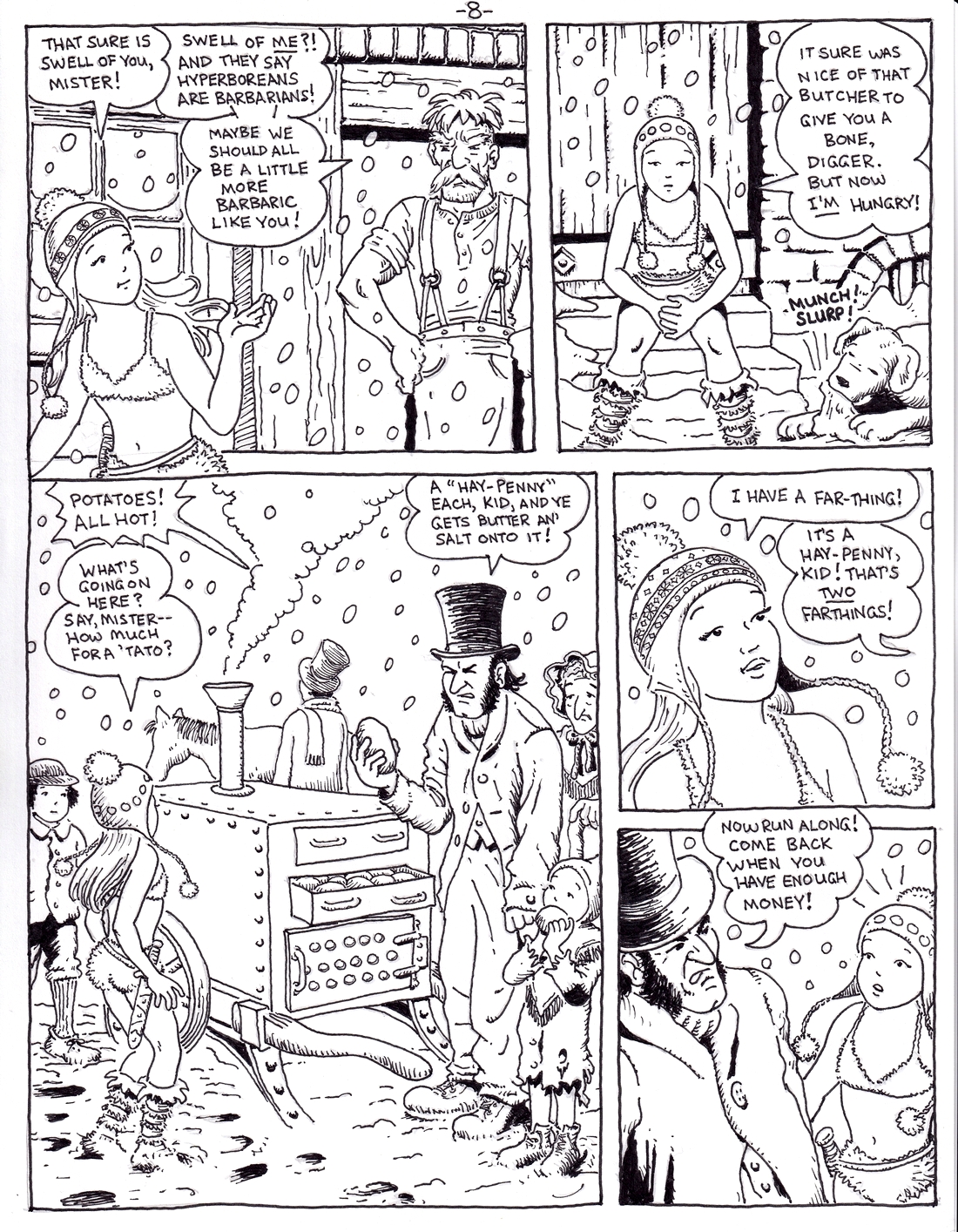
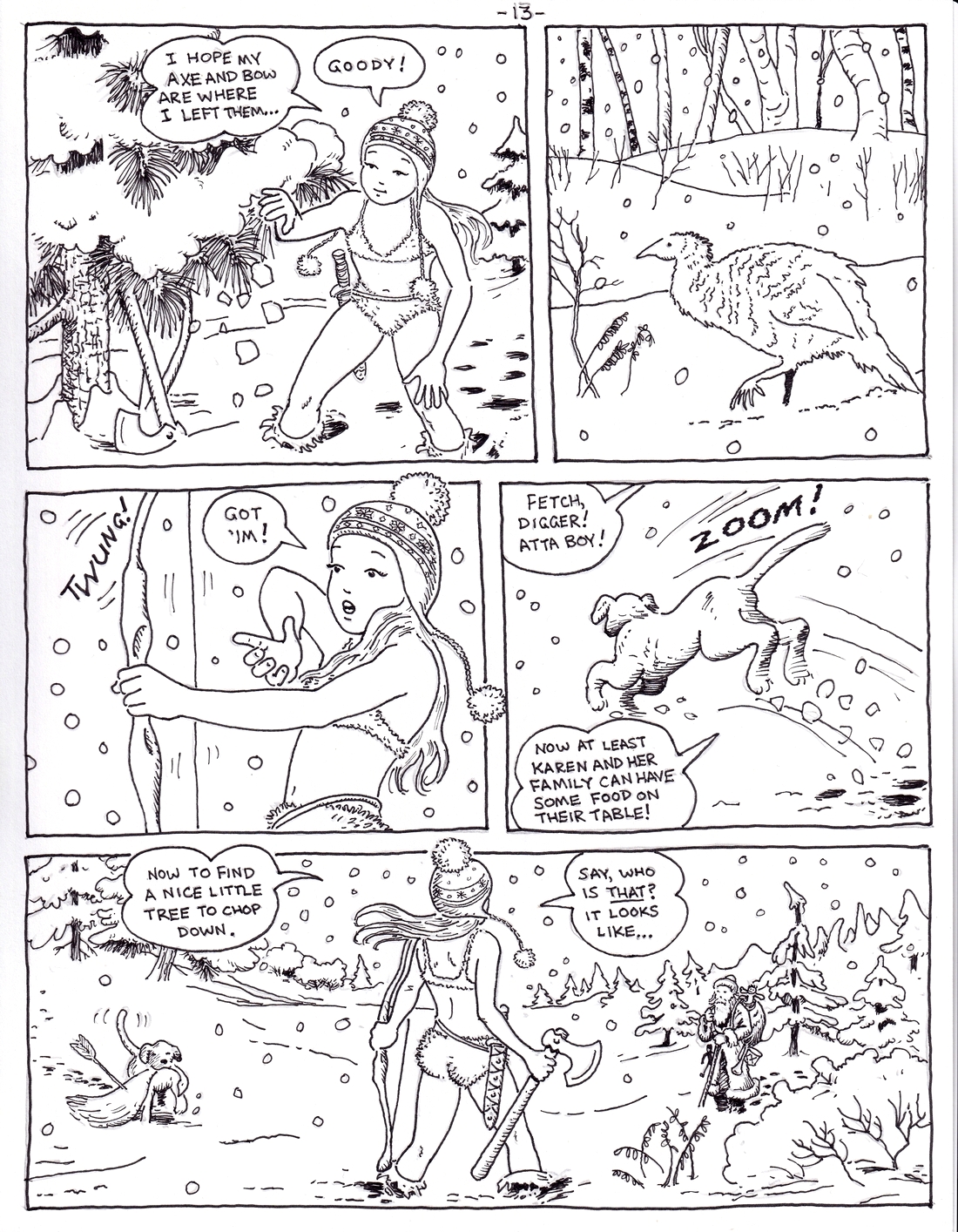
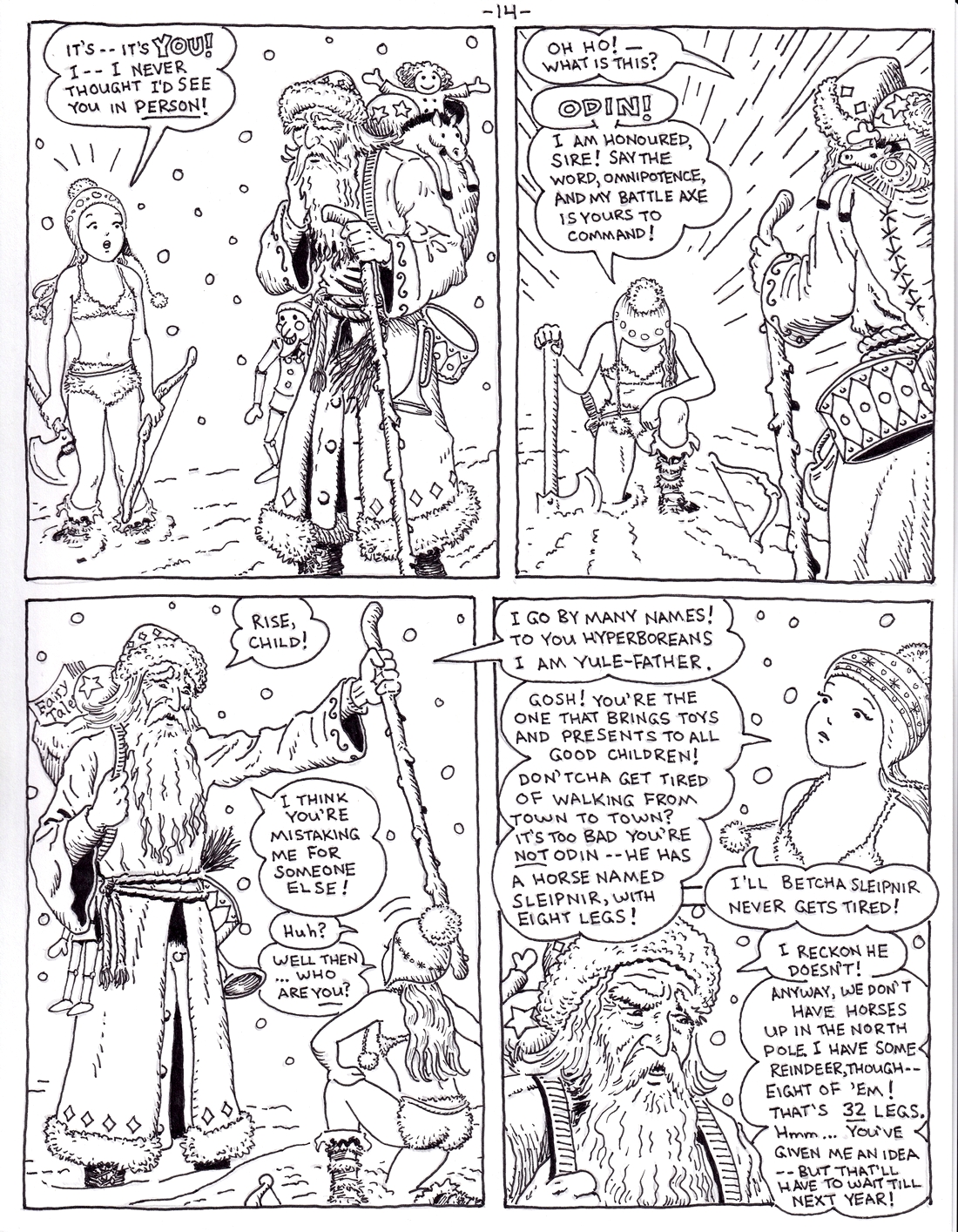
This blog is still alive, even though there hasn't been a post in two years.  And to prove it's been alive the past two years, I'm posting this two-year-old comic, just in time for the Christmas season.  It features May the Hyperborean, a little barbarian girl, in "The Night Before Frostmas".  (Frostmas, as everyone knows, is the first day of winter.)

May first appeared in a prose tale, "Nightmare in Metal", in 1990, followed by her first comic book appearance in PLOGG #1 (August 1994), a small press publication.  She next appeared in a pirate tale, "The Gruesome", in 2011, followed by another comic book adventure, "The Pied-Pirate of Hallowe'en", in PLOGG #6 (2015).

May's travels have taken her (and her dog, Digger) from the northern country of Hyperborea, to towns that exist in various historical eras, simply because they do.  "The Pied-Pirate" has a 1940s setting, and her next comic adventure, "The Night Before Frostmas", is set in the Victorian era.  I'm currently working on her next comic, in which she's hired to star in a thrilling silent film serial in the late 1910s, and in which she also battles a villainous hunchback who brings gargoyles to life.

I'm also working on a new post for Jungle Frolics, but it'll no doubt be a few more months before it's completed.  In the meantime, I hope this Christmas tale is better than a lump of coal in your stocking.


Night Before Frostmas pg1

Night Before Frostmas pg2

Night Before Frostmas pg3

Night Before Frostmas pg4

Night Before Frostmas pg5

Night Before Frostmas pg6

Night Before Frostmas pg7

Night Before Frostmas pg8

Night Before Frostmas pg9

Night Before Frostmas pg10

Night Before Frostmas pg11

Night Before Frostmas pg12

Night Before Frostmas pg13

Night Before Frostmas pg14

Night Before Frostmas pg15

Night Before Frostmas pg16

Night Before Frostmas pg17

Night Before Frostmas pg18

Night Before Frostmas pg19

Night Before Frostmas pg20

Night Before Frostmas pg21

Night Before Frostmas pg22

Night Before Frostmas pg23

Night Before Frostmas pg24

Monday, May 14, 2012

Let Us Not Forget...The Jolly Entertainers!


Formed in 1906, the Jolly Entertainers were a children's band composed of five girls and two boys, six of them orphans.  Their music teacher, Herman Draper, quit his job as superintendent of an orphanage to pursue an idea: a home in which children would fend for themselves, refusing charity and eschewing government intervention.  The home would be funded by the children's own efforts, as they toured the nation giving concerts in every city and town along the way.  It was a foolhardy dream, bound to fail.  Or was it?

Herman Mainard Draper was born in Rainham Centre, Ontario, Canada, in 1856.  He was the son of a preacher, and had eight brothers and sisters.  The family moved to nearby Welland, Ontario, and later to Battle Creek, Michigan.  He was a student at Battle Creek Academy, and taught piano.  He studied at the Boston Conservatory of Music, and also earned a certificate from the Tonic Sol-Fa College in London, England.  Tonic Sol-fa was a simplified method for teaching sight-singing.

On September 18, 1878, Draper married 20-year-old Annie Pacey of Port Stanley, Ontario, and they had two sons: Harry, born 1880 in Battle Creek; and Cecil, born 1882 in London, Ontario, where the Draper's had taken their vows and where Herman was now teaching Tonic Sol-fa.  He also held a class in nearby St Thomas.

Shortly after the birth of Cecil the Drapers moved to Lincoln, Nebraska, where Draper had a job waiting for him at the University of Nebraska's Conservatory of Music.  Draper explained his program in the university's catalogue for the fall term of 1882: "Instruction will include the study of registers, solfeggi, scales and arpeggios; of the different styles of singing; and of English and Italian songs.  In the elementary and chorus classes of this department will be introduced the popular Tonic Sol-fa System, which is justified by its great success in England and elsewhere, and the apparent demand for it in this country."

"Apparent", indeed.  Tonic Sol-fa had its opponents, some of them among the faculty.  Draper's pupils, they contended, would never be able to read standard notation and participate in a conventional orchestra, and thus their education offered little prospect for a career in singing.

Within weeks of the start of the term Draper gave a demonstration of his system, but he won no converts among the skeptics.  Early in 1883 S. B. Hohmann, Director of the Conservatory of Music, hired another teacher, Louise Seacord, "a thorough musician and superior vocalist".  Draper refused to be ousted, and on June 15 he was somehow appointed the new director of the Conservatory.  The minutes of the Board of Regents read: "Resolved, that Prof. Wm. M. Draper [sic] be hereby appointed Director of the Musical Conservatory without salary and that the appointment of S. B. Hohman heretofore made be annulled.  Adopted."  On July 10, his position was confirmed, but Draper's victory was short-lived, as only an hour later the decision was reversed: "Resolved, that the application of Wm. M. Draper for appointment as Director of Conservatory of Music be indefinitely postponed, and that Mr S. B. Hohmann be continued as such Musical Director upon the same terms as heretofore..."

Draper left, but he wasn't about to give up on Tonic Sol-fa.  He gave lessons at local public schools and churches, and placed ads in newspapers.  He taught at St Claire Hall, the fall term beginning September 17, 1883.  On the 2nd day of the 18th annual meeting of the Nebraska State Teachers' Association, held March 25-27, 1884, Draper gave a performance: "In the afternoon, Prof. Draper, with his class of girls, presented a vocal drill in the Tonic Sol-fa system, which was very admirable."  The March 28 edition of the State Journal reported that his "class of 16 girls, ranging in years from 10 to 14, did some excellent work, which spoke louder than words of the superiority of the Tonic Sol-fa system as a teaching medium.  The time being restricted to half an hour, his program was of necessity limited, but during the exercises the whole audience of about 300 teachers seemed deeply interested."  He was garnering acceptance for Tonic Sol-fa, and for the next two years Draper gave demonstrations and lessons in nearby towns, including Seward.  Impressed, the school board of Seward asked him to teach there.

The Drapers moved to Seward in 1887, but not for long.  They went on to Kearney, Nebraska early in 1889, where Draper taught Sol-fa at local schools and put together the Kearney Juvenile Band.  Wherever he went, Herman was successful with his musical method: "It has no lines, no spaces, no clefs, no sharps, no flats, no naturals, no time figures, nothing but music in a plain, practicable, sensible notation as simple and natural as the music itself. Children comprehend and enjoy it and can learn to sing by it as readily and as well as they learn to read from books."

In 1889 it was reported in the Kearney Daily Hub that Draper was "giving extreme satisfaction with his vocal methods of teaching music by the Tonic Sol-fa system in the public schools of this city. The pupils receive certificates for their ability in 'musical memory, singing in time, singing from the modulator, and in ear exercises.' The professor has over a thousand pupils undergoing instruction of whose progress a record is kept."

He also opened Draper's Music Store, and issued a catalogue for his growing stock of sheet music.  He sold instructional books and violin strings, and offered lessons in "piano, violin, guitar and any other instrument..."

Annie Draper's sister, Edith, died of apoplexy in 1894.  She and Herman took in her little girl, also named Edith.

1890s: Herman and Annie Draper, with their two sons Harry and Cecil, and adopted niece, Edith

The Kearney Normal School, Business College, and Conservatory of Music opened its doors for the first time to a mere 50 pupils on September 10, 1895, and Draper, one of the school's incorporators, taught there for some time.

In the late 1890s, the Drapers moved to Calumet, Michigan, in the Upper Peninsula, where Herman opened a new music store and taught voice and various instruments.

During an extended vacation in 1900, he visited Burley, a socialist colony in Washington, established only two years earlier by the Co-Operative Brotherhood.  At that time the colony had a population of 45 men, 25 women, and 45 children.  Draper arrived in May and remained as a guest.  He had already brought two horns with him, and sent back home for more.  Additionally, he borrowed and rented other instruments and formed a children's band, composed of 24 girls and boys. That summer they journeyed to Tacoma and on to Seattle, where a concert was given August 21 at Ranke's hall.  The Seattle Post-Intelligencer reported ahead of the event that the band "has already achieved a good reputation.  An extensive programme has been prepared, consisting of vocal and instrumental selections.  The latter will comprise both band and string music and some fine choruses are included in the vocal numbers."  A fall tour of Oregon resulted in a loss of money, and Draper returned to Calumet.  Without their leader, the children's band lapsed into oblivion.

But Draper's interest in socialism continued, and he read magazine's like Burley's own Co-Operator, and Wilshire's, whose publication offices moved to Toronto after the magazine was banned in New York.

Draper organised the Twentieth Century Mandolin and Guitar Club in Calumet, and within two years its membership grew to 75 kids from 8 to 14 years old.  The club had two pianos, one organ, and some fifty violins, mandolins, guitars and brass instruments, as well as stacks of sheet music and instructional books. 

Draper formed a brass band with 18 of the children, and in 1903 he came up with the idea of occasionally utilising the band to raise money for his new goal: establishing a home for children (patterned somewhat after Burley's cooperative model) in which the little orphans would fend for themselves by giving concerts.  He also wanted to raise money for a vehicle that could transport his band. The Co-Operator reported that "Brother Draper is putting all he has -- his love, his time, his talent and his money -- into this work, and he calls on all interested to correspond with him..."

But Draper's efforts must have failed to raise sufficient funds, for it was in 1903 that he accepted an offer "to take temporary charge of a home-finding association supported by charity", the Good Will Farm, a shelter for homeless kids.  "I expected they would be able to secure a superintendent within a few weeks, but the board of directors decided they had found one in me, so I stayed on the job for three years."

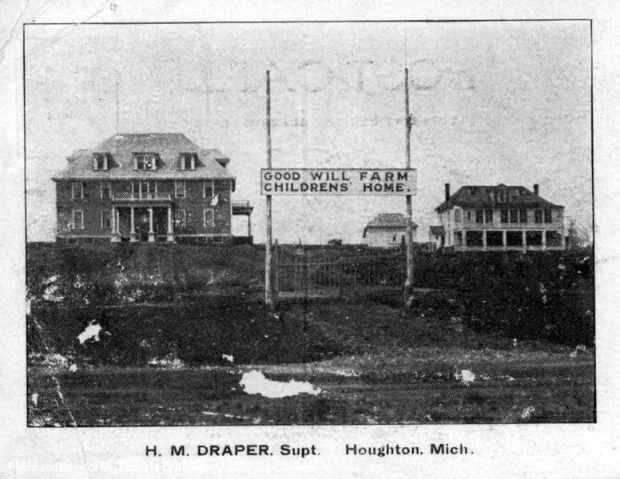
There were only a handful of children at the Good Will Farm, though that number would quickly grow.  It was an actual farm, located three miles outside of Houghton, not far from Calumet.

Vintage postcard.  The photo was also used for a 1905 newspaper article on Draper and the Good Will Farm.

In 1903 a new home was built on the property, which Draper described in an interview two years later: "This is a frame building on a stone foundation and consists of a basement, which is used almost exclusively as a playroom for the children...Here they also have five swings, and one wall is almost covered with band instruments, which are at the disposal of any boy or girl who takes enough interest in music to make use of them, and there is scarcely an hour in the day that some one is not tooting." 

The first floor held the Drapers' private quarters, as well as a school room, dining room and pantry.  "The second floor is divided into girls' dormitory, girls' toilet and bathroom, nurseries, sewing room and bedrooms for the help."  Above that was the boys' dormitory.  Draper was quick to say that the house was "thoroughly up to date", though the grounds needed some improvement.  In 1904 they converted a portion of the property into a "lovely little park on the beautiful shores of Portage Lake."  The park had swings, merry-go-rounds, seats, picnic tables and a bonfire pit.  There was also a barn and stable, where they kept five cows, two calves and three horses.

Another important feature was the printing press, which Draper taught the children to use: "...we set the type and do the press work for Good Will.  With this we are not only disseminating the news of the work being carried on at Good Will Farm to our thousands of patrons, but we are giving our girls and boys the foundation, if not teaching them outright, for one of the most useful trades possible for them to learn."

The Duluth Evening Herald reported that the farm "is supported by contributions from charitably inclined people.  Mr. Draper has organised a band among the children, and they have been giving concerts in several cities in this part of the country for the benefit of the home."  The band performed in numerous cities throughout the Upper Peninsula, and their first tour allowed Draper to pay off $500 of $3000 owed on the new house.  Newspapers gave glowing reviews of successful concerts, and they were much in demand.  The band left July 1, 1906 for a 10-day tour that would prove to be their last.

Photo of the Good Will Farm during winter.

The Good Will Farm's independence ceased when they came under the auspices of the National Children's Home Society.  Draper explained years later: "The new directors at one of their first meetings passed a resolution requiring me to find homes for all children in the home at once.  They also decided, in deference to the wishes of some of the wealthy contributors, not to accept any more illegitimate children, and to accept no babies less than six months old.  At a subsequent meeting they passed a resolution requiring me to secure from the mother a waiver of her rights to the child, and they instructed me that under no conditions must I allow the mother to learn who adopted her child."  Draper said many years later "my wife and I had to make a definite choice between making money or caring for homeless waifs.  We chose the children rather than the cash, and we have never for a moment regretted our choice."  He'd been asked to take charge of a home in Thorndyke, Maine, but declined the offer.

Even before officially leaving his post in mid-August Draper had already reconsidered his plan to start a home in Seattle.  Part of his negotiations with the Good Will Farm was that he be allowed to take the children with him, and this request was granted.  There were twenty-one children, aged 8 to 16, in his personal care.  What he needed now was a vehicle large enough to transport such a large group, and in July of 1906 he made an excursion down to Detroit to inquire about having such a vehicle built.  George F. Strong, whom Draper had met in Houghton, was hired for the job.  A trade magazine reported in November, "The chassis is being built by the Rapid Motor Vehicle Company, of Pontiac, Michigan.  The machine will have 24 horsepower, with an 18-foot wheelbase and 21-foot frame, and will be capable of making 16 miles an hour."

The Rapid Motor Vehicle Company specialised in building trucks and were known for their Pullman Passenger cars, capable of seating 12 people.  The work, which was actually being done in Detroit, was progressing rapidly, as detailed in Automobile Topics magazine:  "The car in general outward appearance resembles a street car, having vestibuled ends.  It is 26 feet long, 7 feet 6 inches wide and 7 feet high inside.  Beneath the seats, which extend along both sides, are lockers for bedding and clothing.  At night the car can be converted into a sleeper by means of iron rods strung across the interior, upon which the cushions will be placed, thus providing two tiers of mattresses."  Upon completion the car seated 22, and was said to be "the only car of its kind in the country", for which Draper paid $3000, the last of his money.

But something had gone terribly wrong.  Draper was forced to restore the children in his care to the Good Will Farm, which must have been heart-wrenching.  Draper convinced the home to make a few exceptions, as he couldn't bear to see families broken up, as they often were.  Ultimately, a much reduced party would make the pilgrimage west.  The children included Herman and Annie's own daughter, Birdie, as well as Italian siblings Mike and Maggie, and four Norwegian brothers and sisters, Hartel, Doloros, Gudrun and Phillis, all from the Good Will Farm.  Postcards were printed to advertise their intentions, showing Draper and the children with their various instruments.  This new band of juvenile musicians was called the Jolly Entertainers.

Though this card was printed after they moved to Des Moines, Washington in 1908, the photo is of the original line-up of the Jolly Entertainers, probably taken in 1906.  Below: the back of the card.


Wasting no time, the Jolly Entertainers made a tour of Michigan and Wisconsin while the vehicle was still in production.  Draper and his band left Houghton for the last time on October 31, 1906, and headed for Detroit.  Accompanying them were Annie and her sister, Louise McKay ("Aunt Lou"), as well as George Strong, who apparently volunteered to drive the vehicle.  Draper had already sent furniture and other belongings to Seattle by freight.

Draper could have had the vehicle delivered to Houghton and taken a more direct route through Wisconsin, but to avoid nigh impassable roads and harsh winters it was decided they'd go down to Indiana and head west from there.  Their first stop was in Jackson, Michigan, where the car was shortened by six feet.  The original length was intended to accommodate twenty-one children, but now there were only seven, so the vehicle was impractical.  Travel was slower than expected.  The top speed of 16 mph was contingent on good road conditions.

They stopped in Elkhart, Indiana, then Goshen, giving concerts.  Their peculiar vehicle attracted attention wherever they went.  Trouble began just after Christmas: following a brief stay in Kokomo, they headed south for Tipton, but were forced to turn back, their vehicle breaking down on a farm road four miles south of Kokomo.  A farmer fed the hungry group, then hauled the vehicle into his barn.  After a phone call to Kokomo, the town officials decided it was best to send the children to White's Manual Labor Institute just outside of Wabash, until Michigan authorities could figure out what to do with them. White's Institute was intended to educate and train troubled and difficult children, and Draper's wards clearly didn't belong there, but it would be many weeks before they were released into his custody.

Postcard, 1906, letting folks know that the Drapers, as well as the Jolly Entertainers, are moving to Seattle.

In the meantime, Draper and Strong were feuding.  Strong was owed money for driving, as well as for repairing the vehicle, which he insisted be paid before continuing the journey to Washington.  At one point, Draper tried to sell the vehicle, but no one else had use for such an odd contraption.  The band played April 10 in Elwood, south east of Kokomo, but went by train.  Fortunately, Draper and Strong were able to settle their differences, and the trip resumed in mid-April.

The spring weather being much more agreeable, they headed north through Illinois.  At every stop they made the Jolly Entertainers played on street corners and sold postcards to stir up interest in their concerts.  The little troupe explained their mission and the postcards sold quickly.  The publicity worked, and the kids rarely played to a house that wasn't filled to capacity.  As well, Draper always made sure the local papers knew they were in town, and reviews were invariably positive.  En route their act had developed from an instrumental and choral concert into vaudeville, by including dance, comedy skits, plays and poetry recitals.

They spent the entire month of August in western Montana, playing extended engagements at theatres in Missoula, Sanders County, and Havre.  As the roads proved too muddy and treacherous for their vehicle, Draper had it loaded onto a flatbed rail car and shipped to Seattle.  The party also took the train, but stayed for a week in Coeur d'Alene, Idaho for a number of performances in September.

Draper's goal from the beginning was to reach Seattle by September, so that the children could start the school year on time, but they didn't arrive until October.  They found a temporary abode in Ballard, which was annexed by Seattle only a few months earlier.  The trip had been an ordeal, but wholly necessary.  Said Draper, "[A]ll of us have the satisfaction of knowing that each worked his or her own way to the promised land."


During their stay in Ballard, the number of children in the home swelled to 20.  In general the kids taken in were orphans or homeless waifs.  In some cases a single parent dropped them off to take a job far away, and paid for their keeping; when they got back on their feet again, they returned for their little one.  "Every child in our home has a story," said Draper.  "Almost all of them represent broken homes or broken hearts."  In perhaps the most extreme case, one girl, aged 10, had witnessed her mother murdered in their hovel.  After a struggle she managed desperately to flee with her little sister.  Both were now in the care of the Drapers.

The Jolly Entertainers while still in Ballard, 1907 or 1908.  The 7 original members have been joined by a growing mob of little musicians.

In June of 1908 Draper found a permanent residence in Des Moines, situated halfway between Seattle and Tacoma.  It was "a run-down hotel with thirty rooms," said Draper, "which could be had for $3,500.  I bought it, paying $50 down and agreeing to pay $50 a month till it was paid for."  The hotel was built in 1890 by John Hiatt (not to be confused with the Hyatt chain of hotels) to accommodate the population of 212 people in the newly founded logging town.

The first telephone lines in Des Moines were put up in 1908, provided by the Pacific Telephone and Telegraph Company; otherwise, the town was still in its primitive stages.  There was little, if any, electricity.  There was no running water -- residents had to pump their own.  Outhouses were common, as there were no sewers.  The privileged owned a septic tank.  There was no highway in or out of Des Moines until 1916, only a wagon-wheel trail.  The most popular form of transportation was the "mosquito fleet", the myriad steamers which plied the waters of Puget Sound, connecting communities.


View of Des Moines, looking west.  At right the Hiatt hotel can be seen; it became the Children's Industrial Home for the next two decades.

The brood kept growing, consisting of homeless waifs, orphans, and abandoned children, mostly children no one else wanted, or that state-run orphanages weren't permitted to keep. Despite being three storeys high and having 30 rooms, the hotel was small, and the Drapers found it impossible to keep more than three dozen children at a time.  The children called Herman "Daddy", and Annie "Mother".

Draper stated in an interview, "Within our home everybody helps every one else.  Housework, simple gardening, and the cultivation of a social instinct which sees the needs of others offers cheery aid, are the domestic studies ceaselessly pursued.  Wholesome food, warm clothing, comfortable beds and clean quarters, plenty of sleep and air and play, with a good season of work, combine to make every member self-respecting, responsible, level-headed, and -- best of all -- level-eyed, as shown by the independent look of equality with which our children approach the world when they give to it the very best of what they have in return for what they actually need."

Postcard, from a photo taken September 11, 1909.  No opportunity wasted, the drum reads "Pictures of the children & home 5 cents each".

A barn, also part of the property, was converted into an opera house, with a stage, curtains and scenery, where the kids provided vaudeville entertainment for the locals, usually musical comedy and theatre.  Draper had a small water tower built, to provide for running water and a toilet on each floor.  In addition, a play area was built on the grounds for the children.


There was also a print shop set up in a little green house out back, "an old shed", as Draper described it.  There were three presses (run by gasoline engine), a composing stone, 55 fonts of type, and other tools.  (By 1915 there were four presses and 75 fonts.)  The press was run by the children, who typeset and printed their own newsletter, The Good Will, as well as programmes and promotional postcards and flyers.  The Good Will contained articles written by the children, sometimes essays about their experiences travelling as the Jolly Entertainers.  These experiences were summed up in a 1917 newspaper article: "The teachers are carried right along so that their education is not neglected and they are always taken to visit all the interesting or instructive features wherever they stop, having seen already what most children only read about.  Going down in the mines, watching the building of ships, going through the great sugar refinery on the coast.  On one occasion they saw sugar from the cane to the table and each received a bag of sugar as a souvenir."  The paper was published monthly, and yearly subscriptions could be had for one dollar.  They also accepted commercial printing jobs: "We guarantee satisfaction and we need your help."

Perhaps their most ambitious printing effort, a small (6" x 4") book, 92 pages.  It contained a history of the group, as well as jokes, plays, poems and articles by the children.  Small press publishing at its finest.  The price was steep, but the cause worthy.

Early photo, date unknown.

Draper also taught the boys how to repair cars and trucks.  The girls learned how to sew and knit.

The Jolly Entertainers travelled in a caravan of trucks, with "Daddy" and "Mother", and usually with one or two teachers in tow.  The children brought their school books.  They also brought their toys, said Draper: "They are ever anxious to romp and play with the children they meet in the towns and cities, and the dollies and trinkets must go with them on their little journeys."  Wherever they went on their tours, the Drapers were always able to find overnight lodging for the children.  This usually wasn't a problem, for, if there weren't enough hotel rooms available, the good citizens of the community would take in three or four at a time.  As one newspaper put it, "Instead of finding it difficult to place the children there were not enough in the party to go around."  Where possible they camped out in tourist parks or municipal parks.

Rare view of the Jolly Entertainers in performance.  Date unknown, but early in their career.

This photo was used on postcards as early as 1909.

Draper described his home as perhaps the only self-supporting children's home in the world: "We do not have any support from the county, town or any public institution or state.  The only way we make money to run the home is by giving concerts in different cities."  And so they did.  Within the first three years they performed hundreds of concerts in the state of Washington alone.

The children attended public school in Des Moines, and the entertainment provided by the Jolly Entertainers was secular.  Draper said, "I do not cram religion down the children's throats.  We try to live the Sermon on the Mount.  Each morning we sing a few gospel songs, read a few verses in the Bible..."  But he didn't teach them to turn the other cheek: "Frequently town children pick on our boys.  I say to my boys, 'No one but a coward picks a fight.  I never want you to strike the first blow, but I want you always to strike the last one.'"


Folded card, 1912.  Draper's manifesto.

Draper was convinced he and his wife gave the children all the love, care and fostering they needed.  Before leaving Houghton Draper had stated that their Seattle home would "be for the purpose of furnishing a residing place for the boys and girls until permanent homes can be found for them."  He would soon change his mind about giving the kids up for adoption.  One of the home's fold out cards stated: "We have no children to give away or place in homes.  This is their home and here they remain until they grow up and want to leave."

Their concerts were successful, if not financially, at least critically.  Attendance was good, and often houses were packed, always to appreciative audiences, as the many newspaper reports attest.  An excerpt from a 1911 newspaper article describes in some detail one of their earlier shows:

The program was a continuous play and was pronounced the best ever given by these little folks.

The first was a scene on the street.  A bunch of children on their way to a picnic are met by Uncle Josh, who is persuaded to go along.  They are followed by Happy Hooligan and Gloomy Gus, who also go to the picnic and get "filled up."

Scene 2 is the picnic full blast, children swinging, skipping, playing ball, boxing, etc.  Uncle Josh is there, according to agreement, gets dumped out of the swings and has a general good time.  Happy and Gloomy are the biggest toads in the puddle and the only break in the festivities is the appearance of a cop who attempts to arrest Happy, but the tables turned on him.  Scene 3 finds a host of people buying tickets for the "big show".  Scene 4 is the big show, given by the Lilliputians and it certainly is a "Big Show".  This part of the program is made up of the most catchy songs, beautiful motions and poses, marches, graceful dances and the most laughable vaudeville ever presented on a Port Townsend stage by young performers.

The company will remain over and give another program tonight with an entire change of bill.

The price for the evening show was 35 cents general admission, 50 cents for reserved seats, and 15 cents for children under 14.  Draper said he paid "from five dollars to one hundred fifty dollars rent for a theatre, depending on the size of the town."

No venue left untrodden, they even performed for a Washington chain gang in 1910.  The children met them at the gate upon their return from work.

Summer, 1910.

Draper didn't forget his roots.  The Jolly Entertainers often toured Canada, mostly the Western Provinces.
 
But Draper's Home and the way it was maintained had its opponents.  In April of 1912, the Jolly Entertainers were playing in front of the Imperial Hotel in Portland, Oregon, when someone from the Child Labor Commission stopped them, as ordered by Mrs Millie R. Trumbull, who, according to an interested party, was "in communication with a minister in the State of Washington who is endeavouring to close Mr. Draper's home for the children.  A bill to turn such homes over to the state was introduced at the last session of the Washington Legislature, but was defeated.  There is no reason why Mr Draper's home should be closed, for he is doing a good work for orphans and half orphans.  They are receiving a musical education by which any of them may go out and earn a livelihood."  Mrs Trumbull didn't see it that way.  "She said all institutions for children should be in charge of the state."
 

Later that year they had to cancel two shows in Moscow, Idaho.  According to Draper, "the probate officer and prosecuting attorney had evidently come in contact with some old fossil, who wanted to become conspicuous as being interested in the welfare of children, so they interpreted the child labour law so closely that they would not allow us to perform in the theatre or even play on the street..."

Busybodies like these were annoyances that Draper had to deal with now and then, along with the occasional police officer upholding a by-law preventing the children from performing in the street.

Folded postcard; this vehicle was probably used for local jaunts.

The Jolly Entertainers performed in Washington all year round, especially locally, and toured widely during the three months of summer vacation.  They were a hard-working band, as the following will attest.  They toured California extensively in 1914, in an effort to raise enough money to pay off their mortgage on the Home.  Draper must have been granted a special dispensation, for they began their long journey in the middle of the school year, January 14, taking the O.W.R. & N. (Oregon-Washington Railroad and Navigation Company) and Southern Pacific railroads from Washington down to Porterville, in the middle of California, then on to Modesto, where Draper bought a three-ton truck, a new body built to accommodate passengers and baggage.  Draper wrote in a 1915 article, "On this machine they carried sixteen trunks of costumes, scenery and school books, two large laundry baskets, thirty hand grips and boxes, twenty-three horns and thirty people, seats being arranged for the passengers above the trunks and other baggage."

Newspaper ad from February 23, 1914.

After numerous performances in many towns along the way, the stopped in Benecia, near San Francisco, where they purchased another truck, as well as a 50 x 100 foot tent (which they erected if a town had no theatre or opera house to perform in), 200 chairs and a piano.  From there they travelled north, with Portland, Oregon as their goal.  "The roads varied from the finest concrete to a common country wagon road, sometimes of hard clay and others of sandy loam, gravel or solid mountain rock."

Sometimes the route was downright treacherous: "The bends in the road at times were so abrupt that our huge trucks were often obliged to move back and forth three or four times before making the turns, at other times they would be scraping rocks on one side, with the mountains extending hundreds of feet above them, while on the opposite side the wheels would ride within a foot or two of the edge, overlooking a steep precipice or a yawning abyss below..."


A photo taken during their gruelling 1914 tour of California.

While crossing the Trinity river one of the trucks crashed through the bridge.  Fortunately it was only the baggage car.  It took four hours to free the truck, during which time the kids took their school lessons.  After that they carried planks and built their own road for 300 feet up a sandy incline, then ran "into a forest so dense and our trucks being so wide that we had to cut down a few trees and chop off branches to get through them."  They also had to ford ten streams, and got stuck in one overnight.

They spent ten months in California, and "performed in 121 different towns and cities, in many of the finest theatres and opera houses of the state.  Entertained the students of over 200 high schools and grammar schools, two state normals, two insane asylums, two state prisons, visited the great oil fields and wells at Coalinga, the gold fields at Oroville, the San Francisco world famous Golden Gate park, the seal rocks, Cliff house, ostrich farms, entertained in the Palace hotel, were invited as guests to theatres, spent a whole evening in Chinatown..."

Draper was a member of the Elks.

Draper ran into considerable trouble December 31st of that year.  The Municipal Charities Commission received word from the State Board of Charities and Corrections "that an organisation consisting of twenty-five children and seven adults, and known as the 'Jolly Entertainers', was travelling in two auto-trucks towards Los Angeles, where it expected to give entertainments, chiefly musical in nature, for the purpose of raising funds to enlarge a children's home located in Des Moines, Washington."

The Commission's investigation of Draper's Home was less than thorough: they simply wired the editor of Welfare Magazine in Seattle.  The reply was terse, of course: "Institution without trustees or equivalent; several prominent men at first approved withdrew several years ago.  Children no good training; taken out as entertainers.  Property in Draper's name.  Now acquiring additional place.  Washington Labour Commission tried to suppress bill but found institution legal."

The Commission concluded that Draper was exploiting the children for his own profit.  When he reached Los Angeles and applied for a permit to perform there they were refused, as it violated the State Child-Labour Law, which prohibited children under the age of 12 from providing entertainment.  Despite the refusal, Draper made arrangements at a theatre to have the band perform.  He and Annie were arrested that evening, and Draper was given a sentence of 180 days in jail and a $250 fine.  The trucks and all the scenery and equipment were seized.

The next day a meeting was held.  Present were representatives of the State Board of Charities, the Los Angeles Humane Society for Children, and the National Child Labour Committee, as well as the Drapers, the children, and their teachers.  A proposition was made by which Draper could be set free.  The agreement read:

We, the undersigned, hereby give you our solemn promise not to give any more performances in the State of California or en route, and to return immediately and directly with the children under out control to Des Moines, Washington, and we further promise that as long as these children are under our control or that we conduct our institution, that we will not give any public performances except those authorised by the Central Council of Social Agencies of Seattle, and that we will at once incorporate our institution as a Children's Home, to be maintained and conducted as such according to the laws of the State of Washington and the recommendations of the Central Council of Social Agencies, Seattle.

It was signed by Herman and Annie, and arrangements were made to send them back to Seattle by boat.  Draper violated his parole by stopping in Oakland to secure a pardon from the Governor.  It wasn't granted.  Once they were back in Washington, beyond the reach of California authorities, it was business as usual for the Jolly Entertainers.


Money was never solicited, but Draper said he wouldn't refuse a "friendly donation".  A 1920 flyer sent round to labour unions asked that each member contribute one penny to the home: "It certainly seems small, but think what it means to those children!"  But he stopped short of calling it charity: "Oh, no!  These kiddies print 'Good Will,' and for each dollar sent as per capita on the one-cent basis they will send a copy of their little paper, which should be passed around at your next union meeting, so that as many members as possible may read it and pass it on to others."

When the children grew up, they left the home, but a few stayed on.  By 1914 two of the original seven Jolly Entertainers were old enough to assist Draper in teaching the children.  Later, a fellow named Lloyd Sawner became the stage manager for the Jolly Entertainers, arranging lights and special effects for the shows.  Julia James, nine years at the home, became a band leader, helping to rehearse the kids.

Above and below: Post card dated Christmas 1913 showing the "Juvenile Quartet", a sort of act within an act.


Around 1918 Draper bought 5 acres of property adjacent to his, which extended to the waterfront, and converted it into a park.  He built a playground for the children.  Over the creek that ran down the middle of the park a bandstand was erected, and beside it a small wooden foot bridge.  Though private property, the park was open to anyone, and a shelter with a large brick fireplace was provided for picnickers.  The park also operated as a campground, for which Draper charged a fee.  The September 1919 issue of "Good Will" described the "monster picnic" at the official opening of the park on Sunday, July 20:

All day long a large steamer plyed the waters between Seattle and Des Moines loaded with capacity crowds.  A continuous stream of autos of every description came over the new brick highway.  The big dancing pavillion with accomodations for 1000 people was one busy whirl of happy dancers and in the beautiful park owned by the Children's Home were over 10,000 Elks and their families seated at tables and lunching on the hillsides and on either side of the beautiful little stream that runs through the park.  The Elks and Marine band gave some fine concerts under the trees, and of course Daddy Draper's kiddies gave quite a program of solos, choruses and band numbers.

On October 31, 1921, courtesy of the Seattle Star newspaper, the kids of the Draper home, Mother Ryther's home, the Theodora home, and the Washington Children's home were treated to an afternoon screening of Mary Pickford in "Little Lord Fauntleroy", based on the children's novel by Frances Hodgson Burnett.  All 150 of the excited kids piled into the Coliseum's balcony seats.  Buses to transport them were paid for by local businesses.  Two days later Draper's kids and the children from Mother Ryther's were treated to a special performance at the Colonial theatre by Jack Hoxie, a star of western films.  Formerly in Wild West shows, he no doubt thrilled the youngsters with his roping expertise.


Their new Ford "Pullman", 1923.

It seems the Jolly Entertainers were inspirational at times.  A Portland magazine reported that after their appearance there in August of 1922, there was a marked increase in sales of instruments.  The local populace were certainly charmed by 6-year-old cornet player, "Baby Edna", who was a hit with audiences everywhere.

Draper, with Baby Edna, performing in the street, c. 1922.

Their longest tour began in June of 1924.  In August they made a stop in Battle Creek, Michigan.  None of the current members of the Jolly Entertainers had even been born when the original lineup left that state. They travelled down the east coast to Florida, where they stayed for the winter.  A teacher was brought along, and their grades were sent back to the school commissioner in Spokane, Washington.


The Jolly Entertainers stayed in Florida during the cold months of 1924/1925.  Below: The back of the card.  Baby Edna's presence drew larger audiences.


Draper once said that the kids they took in to the home were never "picked": "We go to the gutter almost for much of our material.  We take them as providence sends them, and make of them what we can.  It is not our desire or aim to make great artists of the children, nor to urge them to follow the stage in after life.  The entertainments are a means to an end.  That end is to make real men and real women of our charges.  Some of the children may fall short of the mark.  But there is no indication of failure in a single individual now.  Anyway, if failure should come in later life it will not be because of a start in the wrong direction."

The Jolly Entertainers were able to support their Des Moines home for 19 years, but on April 13, 1927 Annie died suddenly from heart failure.  Her funeral was held four days later, without Herman, who had suffered a stroke earlier that morning.  He had a second stroke the next night, April 18, and died at home at the age of 70.

The Jolly Entertainers, circa 1922.

It was a terrible loss for the children, and no doubt a living nightmare, as their world was turned upside down and their future was in doubt.  Matron Elizabeth Oak took charge, but they were now depending on charity, which they were bred to shun.  In November, it was thanks to the goodness of other children that they lasted much longer: A newspaper account read, "Forty youngsters at the Des Moines Children's home will eat chicken, sweet and white potatoes, salad, pumpkin pie and all the trimmings of a regular Thanksgiving dinner today.  And part of it will be provided through the generous giving of Des Moines school children.  All day yesterday trucks and automobiles delivered gifts from school children, including everything from canned goods to potatoes.  Hundreds of jars of canned fruit, vegetables and jam last night lined the shelves of the storage cellar. Barrels and barrels of apples, squashes, pumpkins, carrots and turnips were included in the offering.  The produce should last the home for many months..."

Unfortunately, the home couldn't be maintained without the guidance, inspiration and management of "Mother" and "Daddy" Draper, and so the Children's Industrial Home was closed, and the hotel eventually demolished.

But the children were always determined never to sink into historical oblivion.  The Harrington Opera house, built in 1904 in the tiny town of Harrington, Washington, was bought and restored in recent years, except for the walls of the dressing rooms, which were left untouched, a relic of the past.  The children were only too happy to deface the walls with their signatures, and "The Jolly Entertainers, Sept. 18-19, 1916" is visible, along with other such scribblings for each time they performed there.  Way to go, kids!

Camping in East Potomac Park, Washington, DC, November 25, 1924